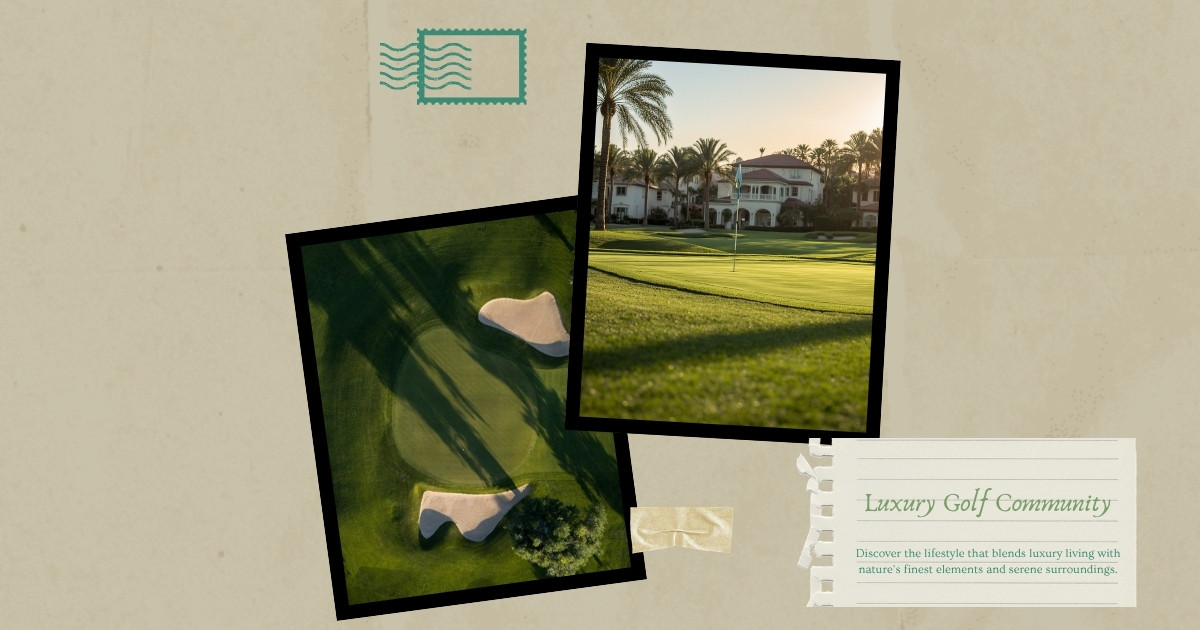
Few amenities move real estate value the way a golf course does. A well-routed course can lift frontage-lot prices by 8 to 30 percent, anchor a masterplan’s identity, and give a township a marketing story that outlasts any brochure. But golf-based residential development is also unforgiving of poor planning: get the routing, buffers, or water strategy wrong, and the same amenity that was meant to carry the project becomes its most expensive liability.
For AECR professionals working across the GCC and India, golf residential is a live and growing typology — government-backed in Saudi Arabia, well-established in the UAE, and a proven luxury differentiator in Gurgaon and Bangalore. This piece sets out the typologies, the design principles that separate a bankable golf masterplan from a fragile one, and the regional nuances — desert irrigation, certification, cost economics — that GCC and India developers need to get right.

A quick note: Golf real estate is a land-value machine, not a golf business
The single fact that should anchor every feasibility study: golf courses embedded in residential masterplans are almost never profitable as standalone operations. An 18-hole course needs 150 to 200 acres and costs anywhere from $5 million (public-access) to $50 million-plus (private or resort-grade) to build, with annual maintenance running $500,000 to well over $1 million — arid-climate courses sitting at the top of that range once irrigation is factored in. The return doesn’t come from green fees; it comes from the premium the course generates on the land around it. That reframing changes every downstream design decision.
Types of golf-based residential developments
Golf residential isn’t one product — it’s a spectrum defined by density, hospitality integration, and how tightly homes cluster around play:
- Golf estates / villa communities — low-density, gated, villa-only, built entirely around the course. Emirates Hills in Dubai is the archetype: Emaar’s first freehold community, wrapped around the Montgomerie-designed course, with plots ranging from 12,000 to 58,000 sq ft and no towers permitted.
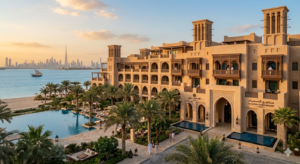
- Golf resort residential — course plus branded hospitality plus residences. Saadiyat Beach in Abu Dhabi pairs a Gary Player links course with a St Regis and a Park Hyatt; Prestige Golfshire in Bangalore anchors a JW Marriott alongside its villas.
- Gated golf townships — large mixed-use masterplans layering residential, retail, schools, and hospitality around a golf core. Jaypee Greens in Greater Noida (452 acres) and DAMAC Hills in Dubai are the clearest examples, mixing villas, townhouses, apartment blocks, and community infrastructure.
- Fairway-front versus interior lots — frontage captures the premium; interior lots, which typically make up more than half of a golf community’s inventory, are far more exposed in a downturn.
- Private membership versus public/semi-private — homeownership and club membership are usually decoupled today. Mandatory-membership models have fallen out of favour because they depress resale values, even though private-course communities still command the highest frontage premiums.
Global comparators are useful benchmarks: Sotogrande/Valderrama in Spain compounds private-course exclusivity with design prestige for 22 to 28 percent premiums; Desert Mountain in Scottsdale runs six Nicklaus courses anchoring homes priced up to $13 million; The Villages and Barefoot Resort represent the active-adult and resort-tourism ends of the US spectrum, respectively.
Masterplan design principles that determine value
Routing drives land use — not the other way around
Course architects route from high point to high point for natural drainage, then developers site residential parcels around that routing to maximise frontage without degrading play. This is the central tension in every golf masterplan: more single-loaded fairways create more premium-frontage lots, but they demand wider corridors to protect golf quality. Get this trade-off wrong and you either sacrifice course quality (hurting the amenity’s marketing value) or under-deliver on frontage lots (hurting the land economics that were supposed to fund the course in the first place).
Frontage typology and the premium it commands
| Frontage type | Typical premium |
|---|---|
| Private members’-course frontage | 8–15% |
| Resort-course frontage | 5–9% |
| Semi-private course frontage | 4–7% |
| Public-course frontage | 3–5% |
| Signature-architect course (Nicklaus, Fazio, Dye, RTJ) | +12–18% on top of frontage premium |
| Combined water-and-golf frontage | 15–22% |
Figures compiled from Savills’ Golf Property Premium Index 2025, JLL Golf Property Research 2025, and the National Golf Foundation’s Real Estate Impact Study 2025. Treat as directional, not definitive — premiums vary meaningfully by market.
Safety buffers are not optional — and they are litigable
USGA ball-dispersion data shows most errant shots land within 150 feet of the fairway centreline. Typical regulatory setbacks require fairways at least 200 feet from residential lot lines, tees at least 100 feet, and greens at least 175 feet — vegetation buffers can offset 10 to 40 percent of that distance. This isn’t a theoretical risk: a Massachusetts jury awarded a couple $4.93 million in December 2021 after 651-plus errant balls struck their home from a single hole at Indian Pond Country Club (the verdict was later overturned on appeal, but the exposure was real). Doglegs are the highest-risk holes and need mounding, bunkering, or landscaping to protect adjacent lots.
Roads, clubhouse, and density gradient
Cart paths for an 18-hole course typically exceed 10 miles and must be separated from vehicular and service roads. The clubhouse — often a $5 million-plus investment — functions as both social anchor and primary marketing device; think of the Norman Clubhouse at Jumeirah Golf Estates or DLF’s colonial-style clubhouse in Gurgaon. Around the golf core, the best masterplans use a density gradient: large villa plots on prime frontage, townhomes and apartment blocks on interior land — exactly how Jumeirah Golf Estates layers its Al Andalus apartments alongside villa sub-communities.
Topography, water, and view corridors
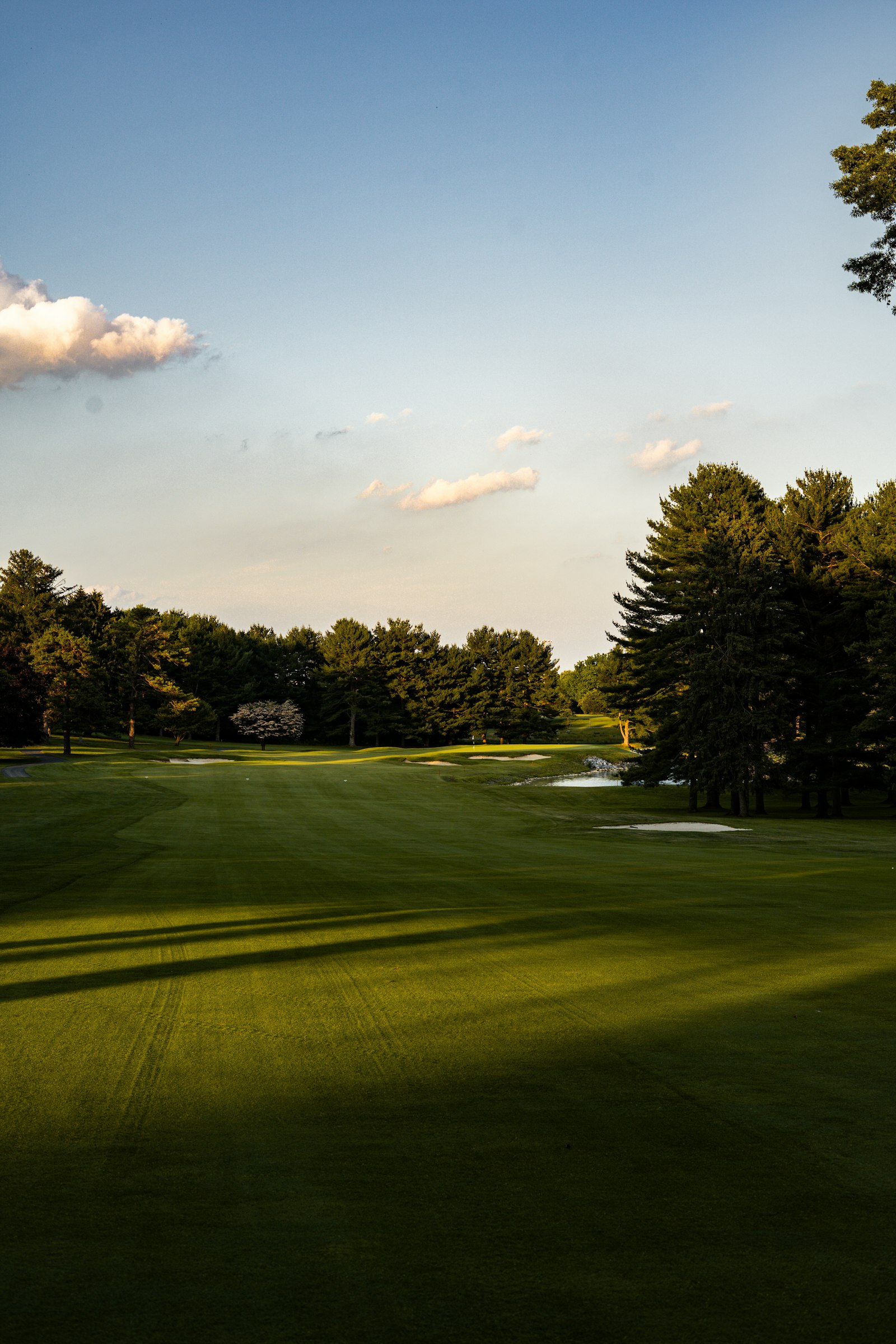
Courses double as green infrastructure: turf filters run-off, ponds manage stormwater, and water bodies (averaging around 11 acres per 18-hole US course) provide passive cooling and irrigation storage. Jaypee Greens in Greater Noida excavated its artificial lakes specifically to generate soil for course contouring — a dual-purpose grading strategy worth replicating. Homes should be sited and oriented — large windows, open plans — to maximise sightlines to greens and water; the view, not just the address, is what buyers are paying for.
GCC and India nuances
Desert golf is a water-engineering problem first, a design problem second
UAE courses each carry 100-plus acres of turf demanding thousands of cubic metres of water daily — Yas Links has been reported using roughly 5,000 m³/day in winter, rising to 7,000 m³/day in summer. The near-universal response is treated sewage effluent (TSE): Emirates Golf Club shifted to 100 percent TSE and cut irrigation consumption by 34 percent; Saadiyat Beach converted to 100 percent treated effluent in March 2020. Turf-reduction and salt-tolerant turfgrass varieties are now standard practice, governed in Abu Dhabi by the Recycled Water and Biosolids Regulations 2021. For a deeper look at the region’s certification and code framework underpinning this shift, see our technical comparison of Estidama and Al Sa’fat and our complete guide to UAE green building certifications.
Certification and evaluation
Regional golf developments are increasingly evaluated through Estidama Pearl (Abu Dhabi — Hudayriyat Golf Estate targets Pearl 3.0), GEO Certified and Audubon Cooperative Sanctuary status (Saadiyat was the first Middle East course to achieve Audubon certification, in February 2020), alongside LEED, GSAS in Qatar, and Al Sa’fat in Dubai for the built residential components.
Market drivers: UAE, Saudi Arabia, India
In the UAE, golf frontage functions as a trophy asset and a Golden Visa qualifier — Emirates Hills villas have reportedly traded above AED 18,000 per sq ft, with prime golf-view plots commanding AED 4,500–7,154/sq ft. DAMAC Hills built its identity around Gil Hanse’s Trump International course; Jumeirah Golf Estates spans 1,119 hectares across two Greg Norman courses and is now expanding via a “Next Chapter” phase adding 12,000-plus units and a Mandarin Oriental resort.
In Saudi Arabia, golf residential is explicitly state-driven under Vision 2030, which targets more than tripling the number of courses nationally — Golf Saudi’s leadership has publicly targeted growth from seven public-access courses to 20-plus within five years. Flagship projects include NEOM’s Gidori (an 18-hole championship course, 200 villas, 190 sea-view apartments, and an 80-room hotel), Qiddiya’s Jack Nicklaus Signature course, and Trojena’s mountain golf concept.
In India, golf differentiates luxury townships rather than defining an entire market. DLF’s Golf & Country Club in Gurgaon — 200 acres, a Gary Player 18-hole course plus an Arnold Palmer 9-hole course, and India’s first floodlit night golf — anchors what is now simply known as Golf Course Road. Jaypee Greens’ 452-acre township and Prestige Golfshire’s 275-acre Bangalore enclave follow the same logic: golf as the organising amenity for a broader luxury residential and hospitality offer.
Cost economics and land allocation
In mixed-use golf townships, the course itself typically occupies 50 to 60 percent of total land, with residential taking up 30 to 40 percent and the remainder going to roads and shared amenities. GCSAA data puts average 18-hole maintenance at just over $1 million for private clubs, with arid-climate/Southwest courses running closer to $1.5 million annually — water alone can account for roughly $266,000 of that. The economic case only works if frontage-lot sales are sufficient to amortise this ongoing cost; if interior lots exceed roughly half of total inventory, that assumption deserves a stress test.
The branded-designer model
Nicklaus Design, Greg Norman, Gary Player, Nick Faldo, and Ernie Els all license their names as real-estate marketing devices, with escalating fee tiers tied to the designer’s personal site-visit involvement. This is the dominant model across GCC flagships — from Al Zorah’s Nicklaus Design course in Ajman to the Norman courses at Jumeirah Golf Estates — and functions much like an architect’s signature does on a building: it adds measurable premium and accelerates sales velocity, but only when the design involvement is genuine rather than a name licence on a compromised site.
Emerging trends: golf is no longer the default, but it isn’t disappearing
In the mature US market, buyer aversion to golf-course living fell from 73 percent in 2003 to 47 percent in 2018, and developers have diversified into wellness trails, community farms, and lake-centred amenities as alternatives or complements. But this is a rebalancing, not a retreat: US course closures dropped to roughly 90 in 2023 — the lowest in nearly two decades — and 2024 saw a record 545 million rounds played across 28.1 million golfers, per National Golf Foundation data.
For GCC and India masterplanners, the practical takeaway is to hedge rather than choose. Even new Gulf flagships are pairing golf with equestrian facilities, wellness programming, and water-sports amenities rather than relying on the course alone. Golf remains a powerful, bankable land-value driver — but it now performs best as the anchor of a broader lifestyle proposition, not the entirety of one.
Recommendations for developers and masterplanners
- Model the course as a cost centre, not a profit centre. Underwrite returns on frontage-lot premium capture and sales velocity, not green fees.
- Maximise frontage without compromising golf quality. Prioritise water-and-golf combined frontage lots — the single highest-premium typology available.
- Design safety in from day one. Hold 175–200 ft green/fairway setbacks and protect doglegs with landscaping; treat this as litigation insurance, not a compliance afterthought.
- Make water strategy the design spine in the GCC. Commit to 100 percent TSE irrigation and salt-tolerant turf from concept stage, and pursue Estidama, GEO, or Audubon certification early.
- Hedge golf with broader lifestyle programming. Layer in wellness, trails, and water-sports amenities rather than relying on the course as the sole draw.
- Use branded design tactically. Pay for the tier that guarantees genuine designer involvement — a name licence on a constrained site destroys the premium it was meant to create.
Golf-based residential development remains one of the most reliable land-value tools available to AECR professionals in the GCC and India — provided the masterplan treats the course as infrastructure to be engineered carefully, not scenery to be dropped in. For developers weighing whether golf belongs in a masterplan at all, the honest answer is: it depends entirely on whether the routing, buffers, and water strategy can be got right from day one.
Have a golf-residential or masterplanning project in the GCC or India and want a second opinion on routing, sustainability certification pathways, or land-use ratios? Reach out to us at mail@greenarchworld.com.