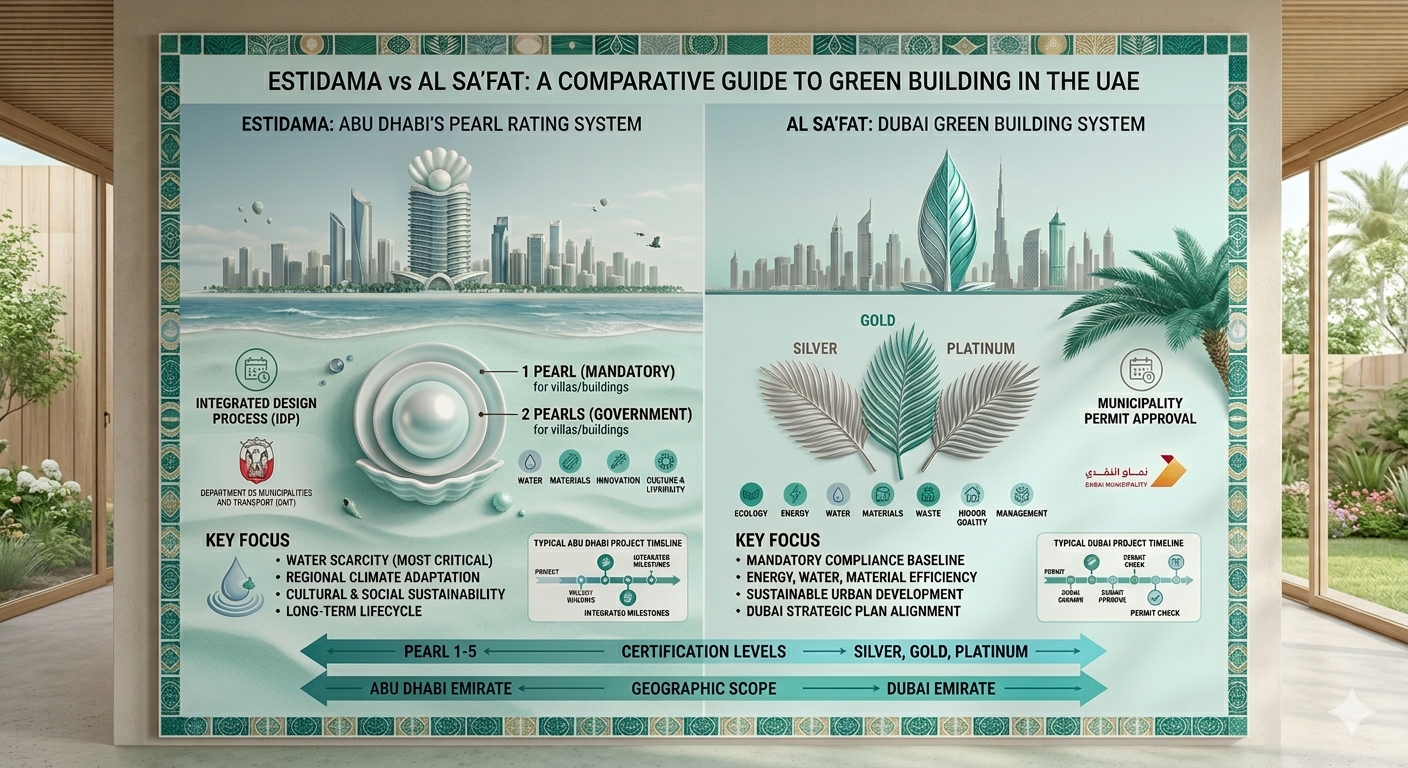
Green building certification in the UAE is no longer a discretionary design choice — it is regulatory, technical, and increasingly tied to both permit approval and long-term asset value. Two mandatory frameworks govern the two largest emirates: the Estidama Pearl Building Rating System (PBRS) in Abu Dhabi and Al Sa’fat in Dubai. Together they cover the vast majority of new construction activity in the country. LEED v4.1 BD+C — the global voluntary benchmark — provides the international reference against which both are measured.
This article is a technical comparison across all major performance dimensions: credit and prerequisite structures, energy modelling methodology, water calculation protocols, indoor environmental quality, materials and embodied carbon, site integration, process requirements, regulatory linkage, and post-occupancy performance. It is intended for architects, engineers, sustainability consultants, developers and investors who need to understand not just what each system requires, but how and why the requirements differ.
System Architecture at a Glance
The three systems share a common objective — reducing the environmental footprint of the built environment — but differ fundamentally in their scoring logic, regulatory authority, and technical anchors.
| Feature | Estidama PBRS (Abu Dhabi) | Al Sa’fat (Dubai) | LEED v4.1 BD+C (Benchmark) |
|---|---|---|---|
| Authority | Dept. of Municipalities & Transport (DMT) | Dubai Municipality (DM) | USGBC / GBCI |
| First issued | April 2010 | 2010 (GBR&S) → Al Sa’fat 2016 → 2nd ed. Jan 2023 → v2.0 (2024) | LEED v4 (2013) → v4.1 (2019) → 2024 update |
| Mandatory? | Yes — 1 Pearl minimum; 2 Pearl for government buildings | Yes — Silver Sa’fa is the mandatory baseline for all new permits | No — entirely voluntary |
| Scoring logic | Points-based; 5 Pearl levels | Threshold-based compliance; 4 tiers (Bronze / Silver / Gold / Platinum) | Points-based; 4 levels (Certified / Silver / Gold / Platinum) |
| Categories | 7 (IDP, NS, LBo, LBi, PW, RE, SM, IP) | 5 (Ecology & Planning, Building Vitality, Energy, Water, Materials & Waste) | 8 (IP, LT, SS, WE, EA, MR, EQ, IN + RP) |
| Min. energy improvement | ≥12% above ASHRAE 90.1-2007 baseline (RE-R1) | ≥20% above ASHRAE 90.1 reference for Silver Sa’fa (Al Sa’fat 2.0) | ≥10% above ASHRAE 90.1-2010 baseline (post-2024 update) |
| Baseline energy standard | ASHRAE 90.1-2007 Appendix G or AD-IECC prescriptive | ASHRAE 90.1 Appendix G or elemental prescriptive | ASHRAE 90.1-2010 (v4) / 90.1-2016 (v4.1) Appendix G |
| Professional credential | Pearl Qualified Professional (PQP) | DM-registered engineering consultant | LEED Accredited Professional (LEED AP) |
1. Credit and Prerequisite Structures
Estidama PBRS v1.0 — Points and Required Credits
Estidama PBRS is organised into seven credit categories, each containing required credits (coded “R” — no points, but mandatory gating prerequisites) and optional credits (1 to 6+ points each). The point ceiling per category is as follows:
| Category | Code | Key Mandatory (R) Credits | Max Optional Points |
|---|---|---|---|
| Integrated Development Process | IDP | IDP-R1 (Integrated Development Strategy), IDP-R2 (Tenant Fit-Out Guide), IDP-R3 (Basic Commissioning) | 13 |
| Natural Systems | NS | NS-R1 (Site Assessment), NS-R2 (Protection), NS-R3 (Design & Management Strategy) | 12 |
| Livable Buildings — Outdoors | LBo | LBo-R1 (Plan 2030 Compliance), LBo-R2 (Urban Systems Assessment), LBo-R3 (Outdoor Thermal Comfort Strategy) | 19 |
| Livable Buildings — Indoors | LBi | LBi-R1 (Healthy Ventilation Delivery — ASHRAE 62.1), LBi-R2 (Smoking Control), LBi-R3 (Legionella Prevention) | 18 (office); 11 (retail) |
| Precious Water | PW | PW-R1 (Min. Interior Water Use Reduction), PW-R2 (Exterior Water Monitoring) | 43 (45 for schools) |
| Resourceful Energy | RE | RE-R1 (Min. Energy Performance), RE-R2 (Energy Monitoring & Reporting), RE-R3 (Refrigerant / Ozone Impact) | 44 |
| Stewarding Materials | SM | SM-R1 (Hazardous Materials Elimination), SM-R2 (Basic Construction Waste Mgmt), SM-R3 (Basic Operational Waste Mgmt) | 28 |
| Innovating Practice | IP | None | 3 (bonus) |
| Total | ~17–20 R credits | 177 + IP bonus |
Pearl levels require: 1 Pearl = all R credits met; 2 Pearl = all R credits + ≥60 optional points; 3 Pearl ≥85 points; 4 Pearl ≥115 points; 5 Pearl ≥140 points. Government-funded projects must achieve a minimum of 2 Pearl.
Al Sa’fat — Threshold-Based Compliance
Al Sa’fat is fundamentally different in architecture: it is not points-based. Buildings must satisfy a fixed list of mandatory clauses within five categories to achieve successive tiers. Each tier adds additional measures rather than awarding optional credits. Failing any single mandatory clause means the tier is not awarded — compliance is binary at every clause. Silver Sa’fa has been the mandatory minimum for all new building permits in Dubai since October 2020 (Administrative Resolution No. 154 of 2020). The five categories are: Ecology & Planning, Building Vitality, Resource Effectiveness: Energy, Resource Effectiveness: Water, and Resource Effectiveness: Materials & Waste.
LEED v4.1 BD+C — Points and Prerequisites
LEED v4.1 BD+C distributes 110 points across eight categories with eight firm prerequisites — including EAp Minimum Energy Performance, WEp Indoor Water Use Reduction, EQp Minimum IAQ Performance, and MRp Construction & Demolition Waste Management Planning. Certification thresholds: Certified 40–49 / Silver 50–59 / Gold 60–79 / Platinum 80+. Unlike Estidama’s per-category point floors, LEED has no minimum per-category score — a project can score zero in Materials and still achieve Gold if it excels elsewhere.
The key structural contrast: LEED’s prerequisites are few and absolute; Estidama’s R-credit stack of ~20 mandatory items is longer and is the mechanism that enforces the 1-Pearl baseline across all typologies; Al Sa’fat embeds all requirements as mandatory tier thresholds, making the system more akin to a building code than a rating programme.
2. Energy Modelling Methodology
Estidama — RE-R1 Minimum Energy Performance
RE-R1 offers two compliance paths. The whole-building simulation route follows ASHRAE 90.1-2007 Appendix G Performance Rating Method, mapping Abu Dhabi to ASHRAE Climate Zone 1 (very hot). The proposed building must improve on the ASHRAE 90.1-2007 baseline by at least 12% for 1 Pearl; typical 2 Pearl projects target ~25% improvement. The prescriptive route uses the Abu Dhabi International Energy Conservation Code (AD-IECC v1.0) and is permitted for buildings with gross floor area ≤5,000 m² (or up to 50,000 m² with prior DPM approval).
Accepted simulation software includes IES VE, DesignBuilder/EnergyPlus, eQUEST, Tas and Trane TRACE. Cooling load dominates: Gulf buildings typically attribute 60–70% of total energy use to space cooling, making chiller efficiency, fan power, glazing SHGC and external shading the principal optimisation levers. The Abu Dhabi outdoor design condition is 46°C DB / 29°C WB.
Al Sa’fat — Elemental and Performance Routes
Al Sa’fat offers two routes under Article 101.01. The elemental (prescriptive) method enforces clause-by-clause compliance with envelope and MEP performance thresholds — including maximum U-values for external walls, roofs and glazing, minimum glazing SHGC limits, and minimum LED lighting efficacy requirements. The performance method requires a whole-building energy model against an ASHRAE 90.1-aligned reference building.
Dubai Municipality has publicly confirmed the energy savings targets delivered by each tier: Silver Sa’fa ≈ 19% energy savings, Gold Sa’fa ≈ 32%, Platinum Sa’fa ≈ 35%. Al Sa’fat 2.0 (2024) tightened the Silver performance pathway to require approximately 20% improvement over the ASHRAE 90.1 reference building — a meaningful step up from the earlier version.
Peer-reviewed simulation research (Alhamlawi, Alaifan and Azar, Energy Policy, 2021) modelled Al Sa’fat’s urban-scale potential and found energy savings ranging from 22% for hotels to 63% for single-family villas, with cumulative macro-economic savings potentially exceeding USD 100 billion over 25 years for Dubai’s entire building stock.
LEED v4.1 — ASHRAE 90.1 Appendix G Performance Cost Index
LEED v4.1 BD+C uses ASHRAE 90.1-2016 Appendix G with the Performance Cost Index (PCI) approach. The proposed building’s PCI must not exceed a Performance Cost Index Target (PCIt) derived from the Building Performance Factor (BPF) — which varies by occupancy type. The March 2024 update raised the EAp Minimum Energy Performance threshold from 5% to 10% improvement for new construction (CS: 8%; Healthcare: 5%). EAc Optimize Energy Performance now offers up to 18 points — split 9 points for energy-efficiency improvement and 9 points for GHG-emissions reduction — the highest point allocation of any single credit in the scorecard.
The key methodological comparison: all three systems anchor to ASHRAE 90.1 Appendix G, but differ in baseline vintage (ASHRAE 90.1-2007 for Estidama PBRS v1.0 versus more recent editions for LEED) and in the improvement threshold required — 12% for Estidama 1 Pearl, ~20% for Al Sa’fat 2.0 Silver, and 10% as LEED’s prerequisite floor with substantial point rewards for going further.
3. Water Calculation Protocols
Estidama — PW-R1 and the Estidama Water Calculator
PW-R1 (Minimum Interior Water Use Reduction) is satisfied through the Estidama Water Calculator — a prescribed spreadsheet downloadable from the DMT — which applies a baseline derived from regional fixture flow rates and compares it to the design case on a fixture-by-fixture basis: water closets, urinals, basin taps, kitchen taps, showers, dishwashers and laundry. Optional PW credits award points for further percentage reductions and for use of alternative water sources. Estidama heavily incentivises Treated Sewage Effluent (TSE) and rainwater harvesting for irrigation and toilet flushing — logical in a context where Abu Dhabi relies almost entirely on desalinated water for potable supply. PW-R2 mandates exterior water monitoring; PW-R3 covers stormwater management.
The Estidama programme targets a national 37% reduction in water consumption. Research, however, has noted that the current PBRS allocates near-equal weight to energy and water — a deliberate design decision reflecting Abu Dhabi’s acute water scarcity — making it the most water-conscious of the three systems at the prerequisite level.
Al Sa’fat — Prescriptive Fixture Caps
Al Sa’fat’s water efficiency regime is prescriptive: Section 600 of the regulation sets maximum fixture flow rates including dual-flush WCs, basin taps, kitchen taps and showerheads. Higher tiers mandate greywater recycling for irrigation and cooling (Gold Sa’fa), rainwater harvesting (Silver), green roofs, and solar-thermal cooling reuse (Platinum). Peer-reviewed analysis (Alhamlawi et al., 2021) explicitly criticises Al Sa’fat’s water provisions as under-weighted — accounting for less than 10% of total mandatory measures — and recommends sharper differentiation between tiers in a country where virtually all potable water is energy-intensively desalinated.
LEED v4.1 — Prerequisite Plus Credits
LEED’s water structure begins with two prerequisites: WEp Outdoor Water Use Reduction (30% landscape water budget reduction, or no permanent irrigation after a 2-year establishment period) and WEp Indoor Water Use Reduction (20% reduction from EPAct 1992 / WaterSense fixture baselines, with WaterSense-labeled fixtures mandatory). Optional credits extend to 50%+ indoor reduction and Cooling Tower and Process Water management. LEED v4.1 introduced a pilot Whole Project Water Use Reduction Alternative Compliance Path that combines indoor, outdoor and process water into a single balance calculation — a more sophisticated approach than either UAE system currently uses.
4. Indoor Environmental Quality
Estidama — LBi and LBo
Estidama’s IEQ provisions span both indoor (LBi) and outdoor (LBo) domains. LBi mandatory prerequisites include: LBi-R1 Healthy Ventilation Delivery (ventilation rates per ASHRAE 62.1, MERV-13 minimum filtration, outdoor air monitoring), LBi-R2 Smoking Control, and LBi-R3 Legionella Prevention (water-system risk assessment). Optional LBi credits cover daylighting, glare control, views, low-emitting materials (VOC limits aligned to LEED-equivalent thresholds), thermal comfort per ASHRAE 55, lighting quality and acoustic performance.
Unusually among major green building systems, Estidama mandates an outdoor thermal comfort strategy via LBo-R3 — prescribing minimum shading coverage percentages on car parks, pedestrian walkways, cycle tracks and playgrounds. This is a direct adaptation to Gulf summer conditions (outdoor temperatures regularly exceeding 45°C) that neither LEED nor Al Sa’fat addresses at the same level of specificity.
Al Sa’fat — Building Vitality
Al Sa’fat addresses IEQ within the Building Vitality category, with prescriptive references to ASHRAE 62.1, filtration to ASHRAE 52.2, CO and CO₂ monitoring in enclosed parking and assembly spaces, low-VOC requirements for paints, adhesives, sealants and flooring (extended in Al Sa’fat 2.0 to all interior finishes), daylighting and views provisions, and acoustic insulation standards for airborne and impact sound. Construction IAQ management is mandatory from Silver Sa’fa.
LEED v4.1 — EQ Category
LEED v4.1 EQ is the most mature of the three: prerequisites for Minimum IAQ Performance (ASHRAE 62.1-2010 with addenda) and Environmental Tobacco Smoke Control, followed by credits for Enhanced IAQ Strategies, Low-Emitting Materials (eight product categories at 75% threshold, 90% for ceilings and floors), Construction IAQ Management, IAQ Assessment, Thermal Comfort (ASHRAE 55), Interior Lighting, Daylight (entry threshold lowered in v4.1), Quality Views and Acoustic Performance. All three systems converge on ASHRAE 62.1 and 55 as the technical anchor; Estidama and Al Sa’fat add explicit outdoor thermal comfort and shading provisions that LEED does not require.
5. Materials and Embodied Carbon
Estidama — Stewarding Materials (SM)
The SM category offers 28 optional points with three mandatory prerequisites: SM-R1 (Hazardous Materials Elimination — no asbestos, no CCA-treated timber), SM-R2 (Basic Construction Waste Management — ≥50% diversion), and SM-R3 (Basic Operational Waste Management). Key optional credits include SM-9 Regional Materials (2 points, sourced within a 500 km radius or nationally), SM-10 Recycled Materials (6 points — the highest single-credit award in the category), SM-12 Reused or Certified Timber (2 points), and SM-13/SM-14 Improved Waste Management (2 points each). Estidama does not currently require Environmental Product Declarations (EPDs) as a prerequisite, though EPDs are frequently used in practice to substantiate regional and recycled-content claims. Peer-reviewed literature (Ramani and García de Soto, Sustainability, 2021) identifies the absence of an embodied-carbon framework in Estidama as a material gap.
Al Sa’fat 2.0 — The Sustainable Materials Passport
Al Sa’fat 2.0 introduces the most significant materials innovation of any UAE green building code: the Sustainable Materials Passport, mandatory from Q1 2026 for all new builds and major extensions (≥50% BUA). The Passport logs all structural materials with quantities, supplier identity, embodied carbon (kg CO₂e per unit) and EPD references where available, and is submitted to Dubai Municipality’s digital registry. Critically, the Building Completion Certificate (BCC) will not be issued without confirmed Passport submission.
In concept, the Materials Passport is analogous in intent to the EU’s Digital Product Passport regulation (which entered into force in 2024) — a project-level, carbon-focused record rather than a product-level disclosure framework. It provides the data infrastructure for Dubai’s net-zero new construction target under the Dubai Urban Master Plan 2040. For most standard villa and commercial projects, the Passport is prepared using standard data for common UAE materials; it is primarily a documentation requirement, not a barrier to using conventional construction materials.
LEED v4.1 — MR and EPD Framework
LEED v4.1 MR has the most mature product-level disclosure framework: MRc Building Life-Cycle Impact Reduction (5 points), MRc Building Product Disclosure and Optimization — Environmental Product Declarations (2 points, with an exemplary performance threshold at 40 products), MRc BPDO Sourcing of Raw Materials (2 points), and MRc BPDO Material Ingredients (2 points, using HPDs, Cradle-to-Cradle or Declare documentation). MRp Construction and Demolition Waste Management Planning is a prerequisite; MRc Construction and Demolition Waste Management (2 points) rewards 50%+ diversion. In summary: LEED has the most developed product-level disclosure regime, Al Sa’fat is rapidly converging via the Materials Passport (project-level, explicitly carbon-focused), and Estidama remains the most regionally calibrated (prioritising local sourcing) but currently lacks an embodied-carbon framework.
6. Site, Urban Context and Planning Integration
Estidama — Natural Systems and Plan 2030
Estidama’s NS category prerequisites enforce a site assessment, protection of existing natural features, and a design and management strategy before any optional credits are considered. LBo-R1 explicitly ties every Pearl-rated project to Plan Abu Dhabi 2030 / Plan Al Ain 2030 / Plan Al Dhafra 2030 — the planning frameworks of the respective municipalities — and LBo-R2 requires an Urban Systems Assessment at local, sub-regional and regional scales. Optional NS credits award points for ecological enhancement (10+ species for maximum award), habitat restoration and remediation. LBo credits incentivise Pearl-Rated Community membership, public transport access (3 points), bicycle facilities (2 points), preferred parking for low-emission vehicles and light-pollution reduction.
Al Sa’fat — Dubai Urban Master Plan 2040 and DBC
Al Sa’fat’s Ecology and Planning category includes building orientation and shading provisions, urban heat island mitigation through cool roofs, light-pollution control and mandatory bicycle parking for residential buildings above a certain height. The system is explicitly aligned to the Dubai Urban Master Plan 2040 and the Dubai Building Code (DBC) issued in January 2022 — which has absorbed the Silver Sa’fa design prerequisites as mandatory provisions, making the DBC and Al Sa’fat a unified regulatory pair rather than parallel frameworks. The Dubai Development Authority (DDA), governing free zones, has adopted parallel Al Sa’fat-aligned requirements.
LEED — Location and Transportation / Sustainable Sites
LEED v4.1 distributes 16 points across LT (transit access, density, bicycle facilities, parking reduction, EV infrastructure) and 10 points across SS (site assessment, open space, rainwater management, heat island reduction, light pollution). The categories are functionally similar in scope to Estidama and Al Sa’fat but use global benchmarks rather than UAE-specific master plans or planning frameworks — a limitation that local practitioners must account for when pursuing dual certification.
7. Integrated Development Process — Estidama’s Procedural Backbone
The IDP is the element that most distinguishes Estidama’s philosophy from both Al Sa’fat and LEED. It is simultaneously a credit category (13 points) and a planning and permitting obligation enforced by DMT. The three mandatory IDP credits are:
- IDP-R1 Integrated Development Strategy — a written sustainability strategy with cross-disciplinary objectives, design charrette outputs, and an implementation plan carried through construction and into operation.
- IDP-R2 Tenant Fit-Out Design and Construction Guide — for Core and Shell projects, ensuring tenant decisions downstream do not compromise the building’s Pearl rating.
- IDP-R3 Basic Commissioning — independent commissioning agent, Owner’s Project Requirements (OPR), Basis of Design (BoD), commissioning plan, functional testing and post-occupancy verification.
The Pearl Qualified Professional (PQP) is the gatekeeper: a professional certified through a Prometric-administered examination who must be embedded in the design and development team, facilitates the IDP, prepares Pearl submissions and is the formal interface with the Pearl Assessor on the DMT side. At least one PQP is required on every Pearl-rated project. There are currently more than 2,000 PQPs across Abu Dhabi.
LEED v4.1 has an IPc Integrative Process credit (1 point) requiring an early-stage energy and water analysis and a design charrette — a much lighter procedural requirement than Estidama’s IDP, which is mandatory, multi-stage and extends through commissioning. LEED’s IPp Integrative Project Planning and Design is a prerequisite only for Healthcare projects. Al Sa’fat has no formal IDP equivalent.
8. Regulatory Integration and Permitting
Estidama — Embedded in Abu Dhabi Planning Approvals
Estidama certification is not an add-on to the permitting process — it is the permitting process. The sequence is: (1) sustainability goals set during IDP charrettes at concept stage; (2) Pearl Design Rating submission at end of detailed design, required to obtain the building permit; (3) Construction Audit Protocol with five verification stages during construction; (4) Pearl Construction Rating submission upon commissioning completion, required for the Certificate of Completion. There are no Estidama certification fees — the system is administered by DMT as part of normal planning and permitting. Failure to maintain compliance mid-construction must be resolved during the audit process, or the Certificate of Completion is withheld.
Al Sa’fat — Dubai Municipality BPS Portal
Al Sa’fat compliance is enforced through Dubai Municipality’s Building Permit System (BPS) portal. A verified Sustainability Statement must accompany all architectural drawings at permit submission — from 2026, the BPS AI scanner automatically checks for a present and compliant statement before passing to human review. Silver Sa’fa is a gating prerequisite for the building permit. During construction, DM inspection teams verify on-site compliance. At handover, DM issues a digital Sa’fa certificate with the relevant tier. Gold and Platinum certificates carry a five-year validity period. The Sustainable Materials Passport must be submitted to the DM digital registry for the Building Completion Certificate to be issued. Non-compliance is subject to permit refusal and fines under Federal Decree-Law No. 11 of 2024 (AED 50,000 to AED 2,000,000).
9. Operational Performance and Post-Occupancy
A persistent gap in both UAE systems is the absence of a mature, formally released operational rating. Estidama defines a Pearl Operational Rating in PBRS v1.0 (requiring ≥2 years of operation and ≥80% occupancy before eligibility) but the operational protocol document has not been published as of mid-2026. The Pearl Design Rating is valid for five years — a shorter validity than LEED’s design certification — reflecting the intent to push buildings back towards operational accountability. Re-commissioning at one and two years post-occupancy is incentivised as an optional credit.
Al Sa’fat has no formal operational rating but requires periodic uploads of energy and water consumption data to Dubai Municipality records after the Sa’fa certificate is issued — providing a monitoring layer without a formalised scoring mechanism. Etihad ESCO’s Dubai-wide retrofit and performance-improvement programme functions as the de facto operational performance vehicle for existing stock.
LEED O+M (now updated through v4.1 and into v5) is the most mature operational framework globally: it requires 12 months of measured performance data, recertifies every five years, and is now the fastest-growing LEED segment. For UAE projects seeking operational credibility beyond the design certificate — particularly those targeting international investors, institutional occupiers or ESG reporting frameworks — LEED O+M remains the only available international benchmark.
10. Quantitative Benchmarks
| Metric | Estidama (Abu Dhabi) | Al Sa’fat (Dubai) | LEED v4.1 BD+C |
|---|---|---|---|
| Energy savings (modelled / reported) | 20–30% (industry reports); 31% programme target | 19% (Silver), 32% (Gold), 35% (Platinum) — DM official (2023); 22–63% range (Alhamlawi et al., 2021, by typology) | Typically 15–35% above ASHRAE 90.1-2010 baseline depending on certification level |
| Water savings target | 37% programme reduction | Prescriptive fixture caps; <10% of mandatory measures per peer review | 20% prerequisite; up to 50%+ for credits |
| Macro-economic savings projection | 20–33% lifecycle cost reduction (industry) | USD 100 billion over 25 years (Alhamlawi et al., 2021 — modelled projection) | Varies; global studies show 10–20% lifecycle cost reduction |
| Certified buildings (approx.) | >5,000 Pearl Construction Rated villas; >260 Pearl Construction Rated buildings; >2,000 PQPs | 72,000 buildings (≈58% of Dubai stock) compliant with green building standards (DM, Q2 2023) | 174 LEED-certified projects in UAE (USGBC 2025); 1,100+ LEED registered/certified cumulatively |
| Carbon avoided | Not separately published | 2.28 million tonnes CO₂ cumulatively (Dubai Media Office, 2023) | Not UAE-specific |
| Rental premium | ~9% for Pearl-rated assets (industry reports) | 10–15% rental premium for green-certified buildings (DM / market reports) | Globally documented 6–12% premium (USGBC / JLL studies) |
| Capital cost premium (certification) | 3–7% for 1 Pearl; 10–15% for 3–5 Pearl | Silver compliance: minimal when designed in from concept; 10–20% for upper tiers | 0–4% (Certified/Silver); 4–10% (Platinum) — global studies |
Key Takeaways for Practitioners
Energy modelling is the common technical language. All three systems anchor to ASHRAE 90.1 Appendix G as their energy performance baseline. The primary variables are the baseline vintage (ASHRAE 90.1-2007 for Estidama PBRS v1.0, later versions for LEED) and the required performance headroom. Projects targeting multi-certification should run a single energy model and map results to each system’s performance metric — significant documentation efficiency is achievable with careful early planning.
Estidama’s IDP is the most procedurally demanding requirement. The mandatory multi-stage Integrated Development Process, sustained by a PQP through design, construction and commissioning, is the element most likely to be underestimated by teams without prior Estidama experience. It is not an administrative overlay — it is the structural spine of the entire certification.
Al Sa’fat 2.0’s Materials Passport is the most significant recent regulatory development in UAE green building. Its mandatory, permit-linked nature from 2026 means embodied carbon documentation is now part of the standard design deliverable set for any new Dubai project — not an optional sustainability exercise. Design teams should integrate this into their specification and consultant briefing processes from RIBA Stage 2 / concept design.
Water efficiency remains the weakest dimension of Al Sa’fat relative to the UAE’s water scarcity context. This is a documented gap in the academic literature and represents an area where voluntary LEED Water Efficiency credits or Estidama-style TSE integration could add genuine performance differentiation for projects in Dubai’s free zones or seeking international investor recognition.
The operational performance gap is real and will close. Both Estidama’s unreleased operational rating and Al Sa’fat’s monitoring regime signal that post-occupancy performance is the next regulatory frontier in UAE green building. Projects delivering LEED O+M alongside local compliance are currently ahead of the curve and positioned for the next phase of market and regulatory evolution.
Green Arch World publishes independent thought leadership on architecture, engineering, construction and real estate across global markets. All technical thresholds cited in this article should be verified against the current controlling regulation documents — Dubai Municipality 2nd edition (January 2023) and DMT PBRS v1.0 — before use in project submissions, as both systems are subject to ongoing revision.
Explore more at greenarchworld.com