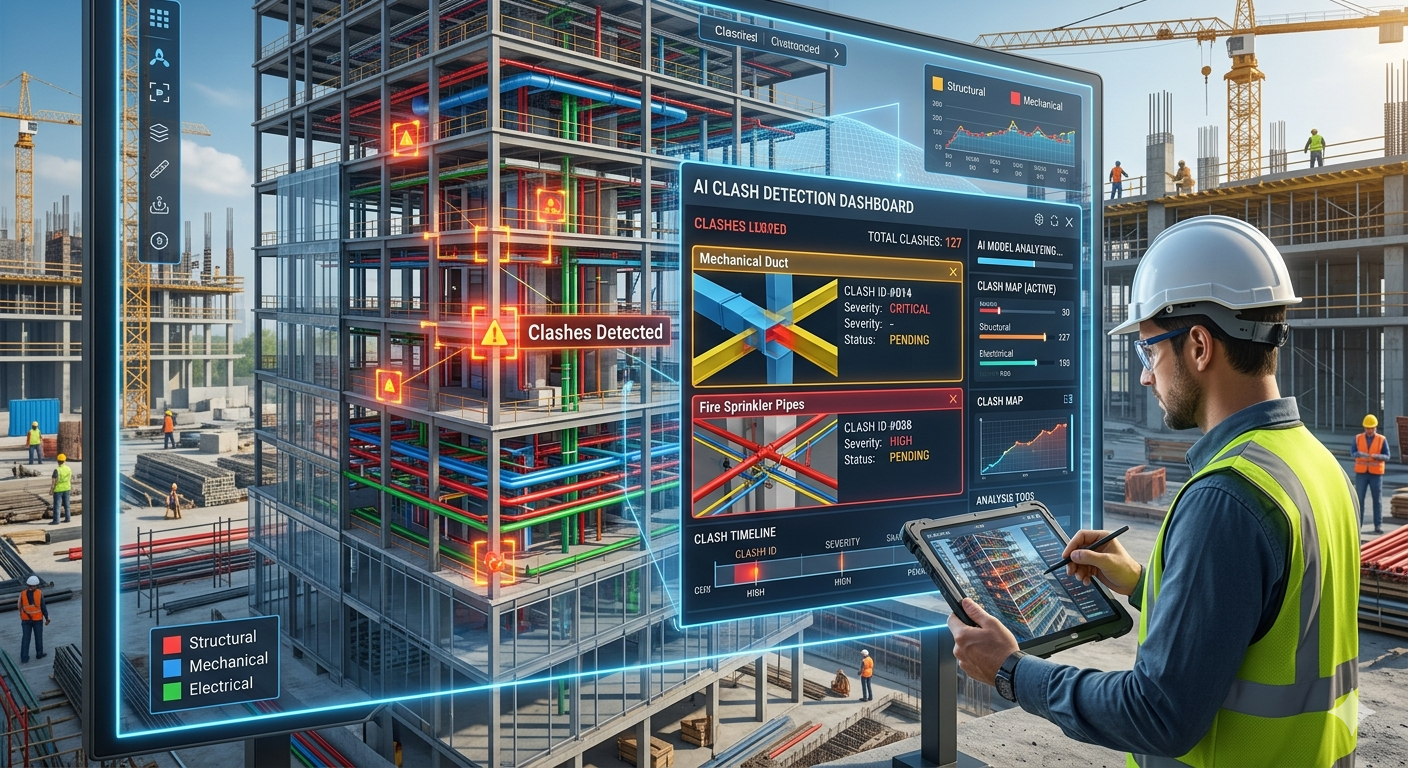
How machine learning, computer vision, and graph neural networks are transforming Building Information Modeling from a reactive coordination tool into a predictive, self-correcting design intelligence layer — and what BIM managers, engineers, and contractors need to know to lead that transition.
1. Introduction: The $177 Billion Coordination Problem
Every year, the global construction industry incinerates a staggering amount of value through avoidable coordination failures. According to a widely cited FMI/Autodesk study, rework, poor data, and miscommunication cost the U.S. construction sector alone an estimated $177 billion annually, with rework specifically representing roughly 5% of total construction spend — about $65 billion per year on a $1.3 trillion industry base (FMI/Autodesk, 2018; 2022). Of that rework, FMI found approximately 48% is attributable to poor project data and miscommunication: 26% to communication breakdowns and 22% to inaccurate or inaccessible information. Peer-reviewed studies aggregated by the Construction Industry Institute place project-level rework anywhere from 4–10% of contract value, with some studies reporting up to 20% on highly complex projects.
Behind those numbers sits a deceptively simple culprit: uncoordinated design. A 2-inch ductwork relocation on paper becomes a $40,000 ceiling demolition on site. A misplaced rebar cage halts a pour. A sprinkler that crosses a structural beam triggers an RFI cascade that ripples across MEP trades for weeks. McKinsey Global Institute, in its landmark Reinventing Construction report, calculated that closing construction’s productivity gap could unlock $1.6 trillion of annual value globally — and identified BIM-driven coordination as one of the seven highest-leverage interventions (McKinsey Global Institute, 2017).
Clash detection has evolved through three distinct generations:
- Manual coordination (pre-2005): Architects and engineers overlaying transparencies on light tables, then later 2D CAD layers in plan/section.
- Rule-based 3D detection (2005–2018): Tools like Autodesk Navisworks, Solibri Model Checker, and Tekla BIMsight running geometric intersection tests across federated models, generating thousands of clashes that human coordinators painstakingly triaged.
- AI-augmented coordination (2018–present): Machine learning models filtering false positives, predicting clash relevance, suggesting resolutions, and — increasingly — preventing clashes before they enter the model at all.
The thesis of this deep dive is straightforward but consequential: AI is not merely automating clash detection. It is collapsing the boundary between detection and prevention, turning a reactive constructability check into a continuous, self-improving design intelligence. For BIM managers, engineers, and construction technologists, understanding the underlying mechanisms — not just the marketing — is now a strategic competency.
2. Types of Clashes in BIM: A Technical Taxonomy
Before we discuss what AI can fix, we need precision about what it is fixing. Clashes in BIM fall into three primary families, with several discipline-specific subcategories that traditional rule-based engines handle poorly.
Hard Clashes
Hard clashes are direct geometric intersections — a duct passing through a column, a beam slicing a wall, a pipe occupying the same volume as a cable tray. These are what every clash engine since Navisworks 2009 has been able to find. They are objective, binary, and (in theory) easy to detect. In practice, even hard clashes generate significant noise: a peer-reviewed study in Automation in Construction reports that automated tools routinely flag thousands of intersections, of which up to 60% are false positives or irrelevant — known overlaps such as a duct intentionally penetrating a wall via a sleeved opening (ScienceDirect, 2025).
Soft Clashes (Clearance Violations)
Soft clashes occur when buffer or clearance zones are violated — insufficient space for valve maintenance, code-required clearances around an electrical panel, the swing arc of a door, or required separation between sanitary and domestic water lines. Rule-based tools can handle simple clearance checks if a coordinator pre-defines the buffer geometry, but they struggle with context: a 6-inch clearance may be acceptable in a back-of-house corridor and unacceptable in an OR plenum.
Workflow / 4D Clashes
Workflow or 4D clashes are temporal: two trades scheduled to install in the same physical space at the same time, equipment delivery routes overlapping with crane operations, or sequence-dependent collisions like a wall being closed before MEP rough-in is inspected. These spatial-temporal clashes are notoriously difficult to detect with geometry alone. Research published in Automation in Construction (ScienceDirect, 2024) demonstrated that combining 4D BIM with mixed-integer linear programming reduced spatial-temporal clash incidence in underground pipeline projects from 45.5% to 0%.
Discipline-Specific Clash Categories
- Structural vs. MEP: The classic offender — beams and slabs against ductwork, conduit, and piping. Resolution typically requires routing changes.
- Architectural vs. structural: Wall-to-column misalignment, finish thickness conflicts, false ceilings against beam soffits. A quantitative IJCRT study of paired Revit/Navisworks models found 23 clashes in residential and 58 in commercial buildings, with structural-architectural and MEP issues dominating (IJCRT, 2025).
- MEP vs. MEP: Cable tray vs. ductwork vs. fire suppression vs. plumbing — typically the densest clash zone.
- Reinforcement (rebar) clashes: Increasingly addressed by graph neural network research; conventional clash engines cannot handle bar-by-bar 3D conflict given the topological complexity (ScienceDirect, 2025).
Where do traditional engines like Navisworks and Solibri fall short? They detect geometry but do not understand meaning. They cannot tell whether a clash is intentional (a sleeved penetration), trivial (a sprinkler tee inside a ceiling void), or high-risk (a beam-piercing main duct). Both tools depend on a human coordinator to triage the noise — a process that on a typical large project consumes the majority of a BIM coordinator’s working week.
3. How AI Changes Clash Detection: Core Technical Mechanisms
“AI clash detection BIM” is not a single technology — it is a stack of complementary techniques applied to different layers of the coordination workflow. Below are the six core mechanisms reshaping the discipline.
3.1 Supervised ML on Historical Clash Data
The foundational application: training classifiers on historical clash datasets where each clash has been labeled by an experienced coordinator as “relevant” or “irrelevant.” Hu and Castro-Lacouture’s seminal 2019 paper in the ASCE Journal of Computing in Civil Engineering compared six supervised algorithms and found Jrip-based rule induction reached approximately 80% prediction accuracy for clash relevance. More recent research uses ensemble models combining Random Forest, XGBoost, and MLPs — with feature sets including element type, distance, local density, and IFC class — to push accuracy higher (ScienceDirect, 2025).
3.2 Natural Language Processing for Rule Authoring
Writing Solibri rule sets or Navisworks clash matrices is a specialist skill. Recent generative AI applications — including LLM-driven interfaces that translate natural-language requirements (“flag every duct within 50 mm of a structural beam in fire-rated assemblies”) into executable model checks — are starting to lower this barrier. Vendors including Autodesk, Trimble, and Newforma have signalled investment in conversational interfaces over their coordination data.
3.3 Computer Vision and 3D Point Cloud Analysis
AI is also bridging the gap between the model and the actual built condition. Reality-capture platforms like OpenSpace and Reconstruct apply convolutional neural networks and SLAM to 360° site imagery and LiDAR point clouds, registering them against the federated BIM to surface as-built vs. as-designed deviations. Transformer-based multi-view learning can classify clash penetration types directly from rendered model imagery, allowing the AI to distinguish acceptable sleeved penetrations from problematic ones.
3.4 Graph Neural Networks for Spatial Relationships
Buildings are graphs: rooms connect to corridors, beams support slabs, ducts feed terminals. Graph neural networks — particularly GraphSAGE and graph convolutional architectures — encode this topology and reason about it. A growing research corpus demonstrates GNN-based change-component prediction in MEP coordination, where the model not only flags a clash but predicts which components are most economically modified to resolve it. Other work applies GNNs to rebar clash avoidance, proposing code-compliant rerouting before the clash even appears in the model (ScienceDirect, 2025).
3.5 Severity Classification and Prioritization
Even after filtering false positives, modern megaprojects can produce thousands of legitimate clashes. AI severity scoring — typically gradient-boosted trees or transformer classifiers trained on resolution cost, schedule impact, trade hierarchy, and historical decision patterns — assigns each clash a priority score so coordinators address the 10% of issues responsible for 90% of downstream rework. Autodesk’s Construction IQ uses this approach, drawing on a training base of more than 150 million construction issues across nearly 30,000 projects (Autodesk News, 2019).
3.6 Federated Model Analysis Across Disciplines
Cloud-based common data environments like Autodesk Construction Cloud, Trimble Connect, Bentley iTwin, and Revizto continuously ingest design models from every discipline and run AI clash analysis automatically as new versions are uploaded. Issues are auto-grouped by system and propagated through BCF (BIM Collaboration Format) to authoring tools — so a clash spotted in the coordination environment resolves itself inside Revit with the right element selected and the right viewpoint pre-loaded.
4. Key AI-Powered BIM Tools and Platforms (Global)
The vendor landscape has fragmented into design-authoring suites, dedicated coordination platforms, AR/reality-capture overlays, and specialty AI startups. The table below benchmarks the most consequential global platforms.
| Platform | Clash Detection Method | AI/ML Capability | 4D/5D Support | Open BIM / IFC Support | Best For | Notable Projects / Data |
|---|---|---|---|---|---|---|
| Autodesk Construction Cloud (ACC) | Cloud-based automatic clash on federated multi-discipline models | Construction IQ ML for risk scoring; auto-grouping; AI clash insights | 4D via Navisworks; 5D via Autodesk Build | IFC import/export; native RVT, NWC, NWD | Large enterprise teams in Autodesk-centric ecosystems | BAM Ireland: 20% issue reduction; 150M+ issues in training data |
| Trimble Connect | Cloud CDE with desktop and browser clash sets, TrimBIM federation | AI-assisted categorisation; Datagrid agents; agentic AI roadmap | 4D via Tekla, SysQue, ProjectSight | Strong IFC, SKP, RVT, DWG, Tekla support | Structural steel, MEP fabrication, prefab workflows | Hyundai Engineering partnership; large infrastructure |
| Bentley iTwin | API-driven clash detection on iModels with suppression rules | Open platform for partner AI; ML at platform layer | SYNCHRO 4D, AssetWise 5D | Native iModel + IFC; strong infrastructure schemas | Rail, road, utilities, civil megaprojects, digital twins | Crossrail (Elizabeth Line), HS2 digital engineering |
| Revizto | Multi-format federation; Revizto+ Automated Clash Detection | AI-assisted grouping; severity heatmaps | Schedule integration; partner ecosystem | IFC, RVT, NWC, DWG, SKP | Multi-stakeholder design coordination, live coordination meetings | AECOM: ~20% reduction in BIM coordinator budget (industry estimate) |
| Solibri (Nemetschek) | Rule-based geometric and information validation, IFC-native | ML-augmented rules; expanding AI roadmap | Limited; integrates with external tools | Best-in-class IFC validation | Compliance, code checking, openBIM QA/QC | Public-sector projects in Italy, Singapore, Nordics |
| Newforma Konekt | Issue-based platform layered atop other clash engines | AI Strategy Packages; intelligent issue routing | Indirect, via integrations | BCF-native REST API; broad add-in ecosystem | Cross-platform BCF coordination, hybrid ecosystems | Large multi-vendor projects requiring tool-agnostic tracking |
| GAMMA AR | On-site visual clash detection via AR overlay of BIM | SLAM, model alignment AI, LiDAR-assisted | Schedule-aware site comparison | Reads RVT, NWC, IFC; integrates ACC, Procore | Field verification, MEP coordination on site | Goldbeck: ~80% QA/QC time reduction, ~$135K weekly savings (vendor estimate) |
| ALICE Technologies | Generative 4D scheduling with model ingestion | Explainable AI optimisation, millions of schedule simulations | Native 4D; cost optioneering | BIM model upload, P6/MSP integration | Schedule-driven workflow clash optimisation | Andrade Gutierrez, Zachry Construction, Implenia |
| OpenSpace | 360° reality capture vs. BIM comparison; visual clash detection in field | Spatial AI, SLAM, computer vision, generative AI insights | Schedule progress tracking | Integrates with major BIM platforms | Reality capture, progress tracking, as-built vs. as-designed | 100K+ projects globally; 95% faster site capture (vendor estimate) |
| Reconstruct | Drone, 360°, and LiDAR-based 4D digital twin | AI for progress vs. plan, predictive risk | Yes — schedule-linked digital twin | BIM model and schedule ingestion | Mid-to-late construction risk and verification | U.S. and global infrastructure programmes |
| Space AI / Genusys AI | Generative MEP/electrical routing with built-in clash avoidance | Generative AI trained on routing logic | Limited at present | Revit-native; expanding | Mission-critical MEP: data centres, hospitals, pharma | 95% of MEP clashes resolved in design phase; six weeks saved (vendor estimate) |
Note: Vendor-reported figures (e.g., 80% QA/QC time reduction, 95% clash resolution) are industry estimates from vendor case studies, not peer-reviewed benchmarks, and should be read directionally rather than as absolute measures.
5. Technical Workflow: The AI Clash Detection Pipeline
5.1 Data Ingestion and Federation
Discipline models — Revit (.rvt), Navisworks cache (.nwc/.nwd), IFC, Tekla, AutoCAD Plant 3D — are uploaded into a coordination space inside a CDE. The platform converts to an internal lightweight representation (TrimBIM, iModel, SVF2) optimised for streaming and analytical queries. A federated model is constructed using shared coordinates governed by the project’s BIM Execution Plan and ISO 19650 information management practices.
5.2 AI Pre-Screening vs. Full Clash Analysis
Rather than running every-element-against-every-element, modern platforms use AI pre-screening: bounding-box and graph proximity heuristics narrow the search space to plausible interaction zones, while ML models filter element pairs known to be irrelevant. Revizto’s AECOM team has reported running “everything against everything” tests producing roughly 3 million raw results in 45 minutes — a volume only manageable with downstream AI grouping.
5.3 Clash Triage: Severity, Discipline, Resolution Tracking
The triaged clash list is auto-grouped and tagged with severity scores, responsible discipline, and suggested resolution path. AI-driven grouping leverages spatial proximity, system membership, and historical resolution patterns — collapsing what could be a 12-screen scroll into a focused agenda for the weekly coordination meeting.
5.4 Integration with BCF for Issue Tracking
Issues are exported as BCF topics — XML-encoded packages including viewpoint, IFC GUID references, comments, and screenshots — that can be roundtripped between coordination tools and authoring software via the buildingSMART BCF API. This makes the AI’s findings vendor-neutral and durable: a clash flagged in Revizto can be opened, reviewed, and resolved inside Revit, ArchiCAD, or Tekla without losing context.
5.5 Closed-Loop Learning
The most consequential — and least mature — part of the pipeline is the feedback loop. When a coordinator marks a clash “not an issue,” “approved,” or “resolved (geometry change),” that label feeds the platform’s training data. Over time, the AI learns the firm’s, project’s, and individual coordinator’s tolerance profile. Bentley’s iTwin platform exposes suppression rules as first-class API objects so suppression decisions become reusable AI signal.
6. Real-World Data and Statistics
Confirmed Industry and Academic Data
- Rework cost: ~5% of total construction spend in the U.S., approximately $65 billion annually (FMI/Autodesk, 2022).
- Total inefficiency cost: ~$177 billion per year in U.S. construction from rework, miscommunication, and poor data (FMI, 2018).
- Productivity gap: Construction labor productivity grew ~1% annually over two decades vs. 2.8% for the world economy (McKinsey Global Institute, 2017).
- Productivity opportunity: $1.6 trillion of additional annual value if construction productivity matched the broader economy (McKinsey Global Institute, 2017).
- BIM ROI: 65% of contractors report positive BIM ROI; over half of heavy BIM users report ROI exceeding 25% (Dodge Data & Analytics, 2021).
- False positive rate: Up to 60% of automated clash detections are irrelevant to construction outcomes (ScienceDirect, 2025).
- ML clash classification accuracy: Jrip rule-based ML achieved ~80% accuracy distinguishing relevant from irrelevant clashes (Hu & Castro-Lacouture, ASCE JCCE, 2019).
- 4D clash optimisation: Spatial-temporal clash incidence reduced from 45.5% to 0% in underground pipeline projects using BIM + MILP (ScienceDirect, 2024).
- Construction IQ training base: 150M+ construction issues across ~30,000 real projects (Autodesk News, 2019).
- Documented project ROI: A $230M Haskell design-build project saw a $200K BIM coordination investment generate over $2.5M in savings — a 10× return.
AI and BIM Adoption Rates
- AI in construction market: $3.93B (2024), projected to reach $22.68B by 2032 (Fortune Business Insights, 2024).
- AI/ML adoption in APAC construction: 37% of firms using AI/ML in 2024, up from 26% in 2023 (Deloitte Australia, 2025).
- Global BIM market: Estimated at $9.03B in 2025, projected to reach $15.4B–$27.1B by 2030–2034 (MarketsandMarkets; Fortune Business Insights).
- Cross-industry AI adoption: 72% of organisations adopted AI in at least one business function in 2024, up from 55% in 2023 (McKinsey State of AI, 2024).
Vendor Case Studies (Industry Estimates)
- Crossrail / Elizabeth Line (UK): First major European project at full BS 1192 collaborative working scale; AI-augmented BIM identified thousands of pre-construction conflicts with verified 3:1 to 12:1 ROI ranges (Crossrail Learning Legacy).
- BAM Ireland: 20% reduction in quality and safety issues; 25% increase in staff time on high-risk issues using Autodesk Construction IQ.
- Goldbeck GmbH (Germany): ~80% reduction in QA/QC time and ~$135,000 weekly savings across 90 sites with GAMMA AR (vendor case study).
- Middle East airport project: $7M savings over 6 months and zero change orders for MEP installation through coordinated Revit/Navisworks workflow (Hitech CADD Services case study).
7. Limitations and Challenges
Garbage In, Garbage Out
AI is downstream of model quality. If an MEP family is miscategorised, an LOD 200 architectural model is clashed against an LOD 400 fabrication model, or coordinate systems drift between disciplines, no amount of ML can compensate. Mixing Level of Development (LOD) specifications alone can spawn thousands of false positives that bury genuine issues. Effective AI deployment depends on rigorously enforced BIM Execution Plans, ISO 19650 information management, and modelling standards.
Interoperability and Proprietary Lock-In
Despite buildingSMART International‘s IFC (ISO 16739-1:2024) and BCF standards, dozens of proprietary formats persist. Round-tripping between Revit, Tekla, ArchiCAD, and Plant 3D still loses metadata. AI models trained inside one platform’s ecosystem rarely transfer to another, and clients often face vendor lock-in once their training history sits inside a specific cloud.
False Positive Overload and Alert Fatigue
Even AI-filtered clash reports can produce more issues than a coordination team can review per cycle. If the AI’s confidence calibration is off, coordinators learn to ignore it — the AI equivalent of an over-tuned smoke alarm. Severity calibration must reflect both the firm’s risk appetite and the project’s contractual context.
Training Data Scarcity and Bias
Most published ML clash research uses datasets in the low thousands of labeled clashes — orders of magnitude smaller than consumer ML systems. Project-type imbalance (residential dominating; complex hospitals and data centres underrepresented) can skew AI severity scoring. Federated and synthetic-data approaches are emerging but remain immature.
AEC Workforce Skills Gap
Deploying AI clash detection BIM tooling demands a workforce comfortable with both modelling discipline and data literacy. McKinsey research projects demand for AI and data analysis skills in construction to rise 60% by 2028. Many firms — particularly mid-market and outside North America/Europe — lack staff who can audit AI outputs critically.
Cost and ROI at Small Project Scales
Cloud CDE subscriptions, AI-tier licensing, and consultant-led BEP overhead can swamp the coordination budget on small projects. The 10× ROI documented on $230M projects does not necessarily scale linearly down to a $5M school renovation. Mature firms apply AI selectively — concentrating it on dense MEP zones, mission-critical projects, and risk-weighted scopes.
8. The Future: From Detection to Prevention
8.1 Predictive Clash Avoidance During Design
Generative design tools — Autodesk’s generative design roadmap, Genusys AI, Auto BIM Route, Space AI — propose routings that are clash-free by construction, satisfying constraints (slope, clearance, code, accessibility) up front rather than fixing violations after the fact. Reported figures suggest 95% of MEP clashes resolved at design phase on early adopter projects (Space AI, 2024 — vendor estimate).
8.2 Autonomous Resolution Agents
The next layer is agentic AI: software that not only flags a clash but proposes, justifies, and — with human approval — executes the geometric change. Datagrid’s Trimble Connect agents, Newforma’s AI Strategy Packages, and emerging Autodesk agentic offerings hint at this future. Academic research on component-dependency networks provides the underpinning for AI that recommends optimal clash-resolution sequences.
8.3 Digital Twin Integration into Operations
Clash detection does not stop at handover. Digital twin platforms — Bentley iTwin, Autodesk Tandem, OpenSpace BIM+ — extend AI conflict analysis into operations, comparing as-installed sensor and reality-capture data against the design model to flag deviations during fit-out alterations and MEP retrofits. buildingSMART has signalled IFC6 development to extend the standard into facility management.
8.4 Regulatory and Contractual Implications
As AI takes on more decisional weight, contracts must catch up. Who owns AI-modified geometry? Where does ISO 19650 information liability sit when a suggestion came from a model trained on confidential historical projects? Public clients — UK Government Construction Strategy, Singapore BCA, GSA in the U.S., and Saudi Arabia’s Vision 2030 BIM mandate — are beginning to encode AI accountability into procurement standards.
8.5 Where the Industry Will Be in 5–10 Years
- Routine projects: clash review reduced from a weekly meeting to a continuous, AI-curated stream of decisions.
- Megaprojects (Crossrail-class, NEOM-class): clash events become a KPI, with AI steering routing decisions across hundreds of contributors in real time.
- Generative MEP design becomes standard for mission-critical typologies — data centres, hospitals, pharmaceutical, semiconductor fabs.
- AI agents draft BCF issues, schedule resolution meetings, and update Revit/Tekla geometry under human supervision.
- The “clash report” gives way to a “constructability score” — a continuously updating index of how buildable the model is.
9. Conclusion: From Reactive to Proactive Coordination
For three decades, clash detection has been one of BIM’s most valuable but most reactive activities — an X-ray taken after the patient is already on the operating table. AI is changing the metaphor entirely. Machine learning models filter the noise; computer vision validates the field; graph neural networks reason about how buildings actually go together; generative design produces routes that never clash in the first place. The economic stakes — $65B of annual U.S. rework alone, $1.6T in unrealized global productivity — make this transition not optional but inevitable.
For BIM managers, the strategic move is not to chase every vendor demo but to treat AI clash detection as an operating-system upgrade for coordination practice: invest in modelling discipline, ISO 19650 governance, BCF-based open workflows, and skills development first, then layer AI capabilities where they generate the highest return. The firms that lead the next decade are the ones that stop treating clash detection as a cost centre and start treating it as a continuously learning intelligence layer.
Further Reading on BIM and Digital Construction
This article is part of greenarchworld.com’s ongoing series on BIM, digital construction, and AI in the built environment. Explore related deep dives:
- OpenBIM and Interoperable Formats: The Data Layer AI Has Been Waiting For — How IFC and open standards form the essential foundation for AI-driven coordination workflows.
- BIM Execution Plan: A Comprehensive Overview — The governance framework that makes clash detection — AI-powered or otherwise — actually work on complex projects.
- Parametric Architecture: Leveraging AI and Visual Programming — How generative and parametric design tools connect to the same AI stack reshaping coordination.