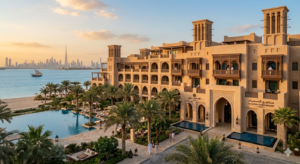
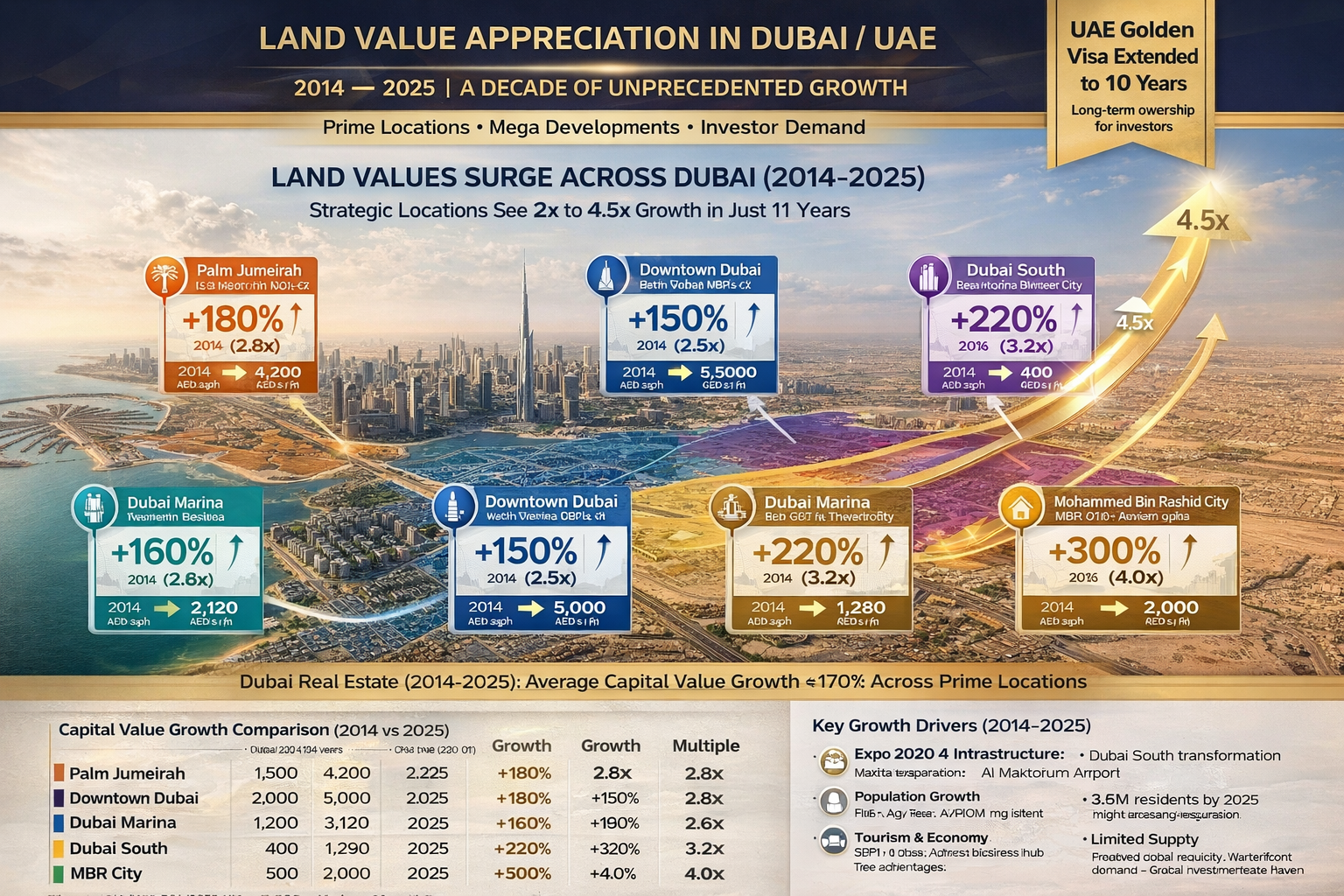
Dubai’s real estate market has undergone a remarkable transformation over the past few years, evolving from a skyline-driven city into a global hub for real estate investment and urban innovation. Between 2020 and 2025, the emirate experienced rapid growth in property values, land transactions, and large-scale developments. Strategic urban planning, strong government support, investor-friendly regulations, and continuous infrastructure investment have collectively strengthened Dubai’s position as one of the world’s most dynamic property markets. As international investors, entrepreneurs, and professionals continue to relocate to the city, demand for both residential and commercial real estate has increased significantly.
Dubai Land Department (DLD): Record-Breaking Market Performance
According to the Dubai Land Department (DLD), the emirate’s real estate sector recorded a total of 2.78 million procedures in 2024 — the highest in its history, representing a 17% increase compared to 2023. Real estate transactions alone totalled 226,000, with a combined value of AED 761 billion — a remarkable 36% growth in volume and 20% growth in value year-on-year.
The momentum has continued into 2025. In the first half of 2025 alone, 125,538 real estate transactions were recorded — up from 99,947 during the same period in 2024, a 26% increase — with a total value of approximately AED 431 billion. April 2025 set a new record with AED 62.1 billion in monthly sales, the highest ever. By August 2025, year-to-date sales had already reached AED 441.22 billion across 137,013 completed deals, a 34% increase on the same period in 2024.
Source: Dubai Land Department — 2024 Annual Report | DLD H1 2025 Results
| Year | Total Transaction Value | Number of Transactions | YoY Value Growth |
|---|---|---|---|
| 2022 | AED ~300 billion | ~80,000 | — |
| 2023 | AED ~470 billion | ~133,000 | ~57% |
| 2024 | AED 761 billion | 226,000 | +20% |
| H1 2025 | AED 431 billion | 125,538 | +25% (vs H1 2024) |
Dubai also attracted 110,000 new investors to its real estate sector in 2024 — a 55% increase — while H1 2025 saw 59,075 new investors entering the market, contributing AED 157 billion, with UAE residents accounting for 45% of new entries.
JLL: Land Market Transformation — A 403.6% Surge
Global property consultancy JLL has provided the most comprehensive analysis of Dubai’s land market in its report “Beyond the Skyline: Dubai’s Land Market Transformation Story”. The findings reveal a structural, fundamentals-driven transformation — not a speculative cycle.
| Metric | 2019 | 2024 | Growth |
|---|---|---|---|
| Total land transaction value | AED 13.7 billion | AED 68.8 billion | +403.6% |
| Number of land transactions | 691 | 1,991 | +188.1% |
| Freehold area transaction volumes | Baseline | — | +495.8% |
| H1 2025 land transaction value | — | AED 43 billion | +42.9% YoY |
| Apartment prices (avg) | Baseline | — | +63.5% |
| Villa prices (avg) | Baseline | — | +116.3% |
| Prime office rents (AED/sqft/yr) | AED ~203 | AED 359 | +76.8% |
| Grade A office rents (AED/sqft/yr) | AED ~140 | AED 238 | +69.9% |
JLL attributes this surge to three reinforcing factors: demographic momentum (Dubai’s population grew from 2.3 million in 2014 to over 4 million in 2025, projected to reach 5.8 million by 2040); infrastructure investment (approximately AED 39 billion allocated in 2025 alone); and regulatory evolution (including the 2025 freehold conversion of 457 plots along Sheikh Zayed Road and Al Jaddaf, blockchain-enabled transactions, and mandatory escrow accounts).
Notably, 44% of all land deals since 2019 occurred within just 18 months (2024–H1 2025), signalling accelerating, fundamentals-driven growth. Top investment locations in this period included Dubai Islands (AED 7.3 billion), Business Bay (AED 6.2 billion), Reem, and Dubai South.
On the commercial side, JLL’s data shows prime Dubai office vacancy at a historic low of 0.0%, with Grade A vacancy at just 4.6%. Prime retail rents in Dubai rose 13.5% in 2025, while the citywide retail vacancy rate stood at just 7.5%.
Source: JLL — Beyond the Skyline: Dubai’s Land Market Transformation Story | JLL UAE Commercial Real Estate Q2 2025
Knight Frank: Prime Residential Market & Luxury Sector
Global real estate consultancy Knight Frank has tracked Dubai’s residential market through quarterly reviews, with its Q3 2025 report highlighting sustained, unbroken quarterly growth since late 2020.
| Segment | Average Price (AED/sqft) | Growth Since Q1 2020 |
|---|---|---|
| All Dubai apartments | AED 1,798 psf | +69% |
| All Dubai villas | AED 2,250 psf | +124% |
| Prime 10 neighbourhoods (avg) | AED 3,767 psf | +140% since Q1 2019 |
| Palm Jumeirah luxury villas | AED 5,394 psf | — |
Knight Frank’s Destination Dubai 2025 report confirms that the total value of transactions across all sectors topped US$ 207 billion in 2024. Dubai recorded 435 sales of homes valued above US$10 million in 2024 — the world’s busiest market for super-prime homes for the second consecutive year, nearly equalling London and New York combined in that segment. In Q1 2025, Dubai led globally with 111 super-prime deals totalling US$1.9 billion.
Knight Frank’s Wealth Report 2025 found that prime property values in Dubai increased by 147% over five years — meaning a US$1 million investment in prime Dubai property in 2020 would be worth approximately US$2.7 million by 2025. The firm forecasts mainstream residential price growth of around 8% for 2025, with prime residential growth at 5%.
Knight Frank also flags a growing supply risk: only 46% of promised housing was delivered on time in Q1–Q3 2025, and while 300,000+ units are expected by 2029, the long-term completion rate of 36,000 per year may not meet projected population-driven demand of 37,600–87,700 new homes annually through 2040.
Source: Knight Frank Q3 2025 Dubai Residential Market Review | Knight Frank Destination Dubai 2025
Bayut: Community-Level Price Trends Across Segments
Bayut, the UAE’s leading property portal, tracks advertised prices across affordable, mid-tier, and luxury segments. Its 2025 annual report highlights sustained price growth across all tiers, with the market entering a more mature phase characterised by genuine end-user demand rather than speculation.
| Segment | Area | Approx. Price/sqft (AED) 2025 | YoY Change (vs 2024) |
|---|---|---|---|
| Affordable Apartments | Dubai Silicon Oasis | ~AED 900 | +9.5–28.5% |
| Arjan | ~AED 1,355 | +12–20% | |
| Dubai Sports City | ~AED 950 | +10–18% | |
| Mid-Tier Apartments | Jumeirah Village Circle (JVC) | ~AED 1,320 | +5–12% |
| Business Bay | ~AED 2,307 | +4–17% | |
| Luxury Apartments | Downtown Dubai | ~AED 2,600 | +4.2–6.5% |
| Dubai Marina | ~AED 2,188 | +4.2–6.5% | |
| Palm Jumeirah | >AED 3,500 | Premium pricing | |
| Affordable Villas | DAMAC Hills 2 | Lower range | +12.9–23.5% |
| Dubai South | Lower range | +11.3–38.9% | |
| Mid-Tier Villas | Al Furjan | Mid range | +17.4–27.8% |
| Arabian Ranches 3 | Mid range | Highest growth in segment | |
| Luxury Villas | Dubai Hills Estate | Premium | +11.1–15.7% |
| Arabian Ranches | Premium | +11.1–15.7% |
Bayut CEO Haider Ali Khan noted: “Dubai’s property market is entering a more mature phase, where new supply is increasingly aligned with genuine end-user demand rather than short-term speculation.” Rental yields in 2025 remain attractive across the city, with the citywide gross average at approximately 6.8%, and affordable communities continuing to see upward rental momentum of up to 21% in asking rents.
Source: Bayut Dubai Sales Market Report 2025 | Bayut H1 2025 Report
Standout Investment Communities: Price Appreciation Hotspots
Several communities across Dubai have emerged as standout investment hotspots due to their strong price appreciation and lifestyle offerings:
| Community | Approx. Price 2021 | Approx. Price 2025 | Approx. Growth | Key Driver |
|---|---|---|---|---|
| Dubai Hills Estate | AED 633/sqft | AED 2,418/sqft | ~282% | Master-planned, golf, schools |
| Palm Jumeirah | Baseline | AED 5,394/sqft (villas) | ~386% | Global luxury demand, waterfront |
| Business Bay | Baseline | AED 2,307/sqft (apts) | Strong | Commercial hub, urban living |
| Dubai South | Baseline | Appreciating rapidly | +38.9% (2025 alone) | Al Maktoum Airport expansion |
| Dubai Creek Harbour | — | — | Strong | Waterfront, mixed-use |
| Arabian Ranches 3 | — | — | Highest in mid-tier (2025) | New handovers, family demand |
Off-Plan Market & The Luxury Segment
A significant trend shaping the market is the dominance of off-plan property investments. Off-plan sales accounted for approximately 65–72% of all residential transactions in 2025, with flexible 60/40 and 70/30 payment plans from major developers including Emaar, Sobha, DAMAC, and Azizi drawing first-time global buyers. By October 2025, 131,504 units had been launched by 228 developers.
At the luxury end, the market has seen extraordinary expansion. According to Knight Frank, transactions of homes priced above US$10 million increased from 469 deals in 2020 to 435 in 2024 — and the average transaction value in this bracket is rising faster than the number of deals, indicating rapid price escalation. Available listings for AED 50 million+ properties fell by 48% in 2024 compared to 2023, as genuine end-users absorb ultra-prime stock. Palm Jumeirah remains the epicentre of luxury, accounting for 37.5% of all $10M+ deals, while Palm Jebel Ali is emerging as the next major luxury destination.
Commercial Real Estate: Office & Retail
Dubai’s commercial real estate sector has experienced equally compelling growth. According to JLL’s Q2 2025 commercial report:
| Segment | Metric | Q2 2025 Value | YoY Growth |
|---|---|---|---|
| Prime offices | Rent (AED/sqft/yr) | AED 359 | +17.3% |
| Grade A offices | Rent (AED/sqft/yr) | AED 238 | +19.5% |
| Grade B offices | Rent | — | +16% |
| Grade C offices | Rent | — | +22.9% |
| Prime office vacancy | Vacancy rate | 0.3% | Historic low |
| Citywide office vacancy | Vacancy rate | 7.7% | Declining |
| Prime super-regional retail | Rent (AED/sqft) | AED 826 | +15.1% |
JLL warns that prime and Grade A rental growth may be nearing its peak as affordability tightens for corporate tenants. New project launches have been noted primarily outside core Central Business Districts, mostly using strata-title ownership structures that do not typically meet large corporate tenant requirements.
Long-Term Outlook: Dubai 2040 Urban Master Plan
Looking ahead, Dubai’s real estate sector is expected to maintain strong long-term momentum. Dubai’s population is projected to reach approximately 5.8 million by 2040 (Knight Frank’s low-growth scenario) or up to 8.6 million under higher growth assumptions. Knight Frank estimates the city will need between 37,600 and 87,700 new homes per year through to 2040 to accommodate this growth.
The Dubai Real Estate Strategy 2033 aims to double the sector’s contribution to GDP, foster innovation and technology in property markets, and attract investments from emerging markets. The Dubai Economic Agenda D33 targets positioning Dubai among the world’s top three urban economies. Together, these policy frameworks — combined with the ongoing infrastructure pipeline and progressive freehold regulations — are expected to sustain long-term real estate value appreciation across the emirate.
Industry forecasters including Knight Frank, Cushman & Wakefield Core, and market CEOs project 10–15% transaction volume growth in 2026, with price appreciation moderating to a more sustainable mid-single-digit level of 5–8% as the market matures.
Conclusion
Dubai’s real estate transformation is not merely the result of market cycles but the outcome of long-term strategic planning and global investment appeal. From luxury waterfront islands to master-planned residential communities, the city continues to create diverse opportunities for investors while building a modern, resilient, and globally competitive urban landscape. As corroborated by data from the DLD, JLL, Knight Frank, and Bayut, Dubai’s land and property values have undergone a structural, multi-year shift — driven by demographic growth, infrastructure investment, regulatory reform, and deepening global wealth inflows. As Dubai continues to grow, its real estate market is poised to remain one of the most influential and innovative property sectors in the world.
Key Data Sources & Further Reading
- Dubai Land Department — 2024 Annual Real Estate Performance
- DLD — H1 2025 Transaction Results
- JLL — Beyond the Skyline: Dubai’s Land Market Transformation Story
- JLL — UAE Office Market Dynamics Q3 2025
- Knight Frank — Dubai Residential Market Review Q3 2025
- Knight Frank — Destination Dubai 2025
- Bayut — Dubai Sales Market Report 2025
- Bayut — Dubai Sales Market Report H1 2025
- Bayut — Average Price Per Square Foot in Dubai 2025
Related Articles
- REITs: Investing in Real Estate Investment Trusts — Wondering how to invest in Dubai’s booming property market without buying directly? This comprehensive guide covers how REITs work, UAE REITs (including Dubai Residential REIT and ENBD REIT), Singapore S-REITs, and a full India–UAE–Singapore returns comparison.
- Long-Term Rental vs Airbnb vs Vacation Home: A 5-Year Net Return Comparison in AED — If you own property in Dubai, this analysis breaks down which rental strategy delivers the best net return over five years, with full cost modelling.
- Real Estate Feasibility — Massing Studies — A step-by-step guide to technical feasibility and test fit studies for real estate development projects.