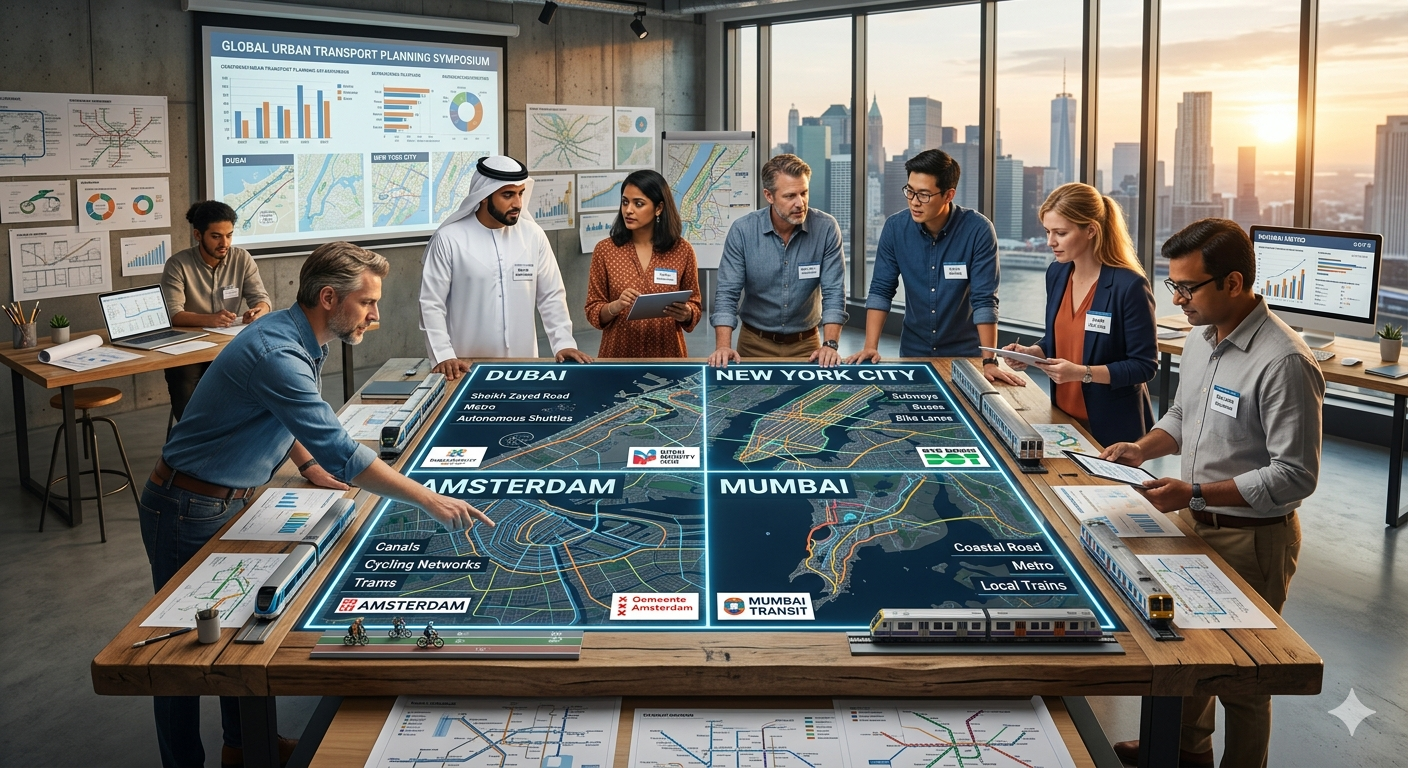
Every day, more than 17 million people step out of their homes in Dubai, New York, Amsterdam, and Mumbai and face a radically different answer to the same question: how should a great city move its people? One city bets on driverless trains and flying taxis. Another has spent fifty years stubbornly reclaiming its streets from cars. A third runs the biggest 24/7 metro in the Western Hemisphere and just launched America’s first congestion toll. The fourth moves 7.5 million commuters a day on a suburban rail network so crowded that up to sixteen people stand on a single square meter. Comparing them isn’t just a transport exercise — it’s a window into how climate, politics, wealth, and culture shape the architecture of daily life.
Dubai: A Desert Megacity Betting on Driverless Everything
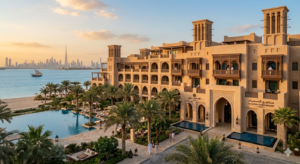
Dubai is what happens when a city with fewer than 40,000 residents in 1960 decides, six decades and 80-fold growth later, to leap straight from highways to robotaxis. Its driverless Dubai Metro — the world’s longest fully automated metro from 2009 until Riyadh overtook it in late 2024 — now carries nearly 295 million riders a year across 89.6 km of air-conditioned track. Add the Dubai Tram (the first in the world with platform-screen doors on an open-air line), a Euro-6 bus fleet, traditional wooden abras charging just AED 1 per creek crossing, and a rapidly-growing cycling network, and total public transit plus shared-mobility ridership reached 802 million trips in 2025 — roughly 2.2 million a day.
Yet Dubai remains profoundly car-shaped. With 540 cars per 1,000 residents — nearly double New York’s rate — and daytime vehicle counts hitting 3.5 million, the emirate is trying to out-engineer its own sprawl. The Dubai 2040 Urban Master Plan wants 55% of residents living within 800 metres of mass transit and adopts a “20-minute city” model where 80% of daily needs are reachable on foot or bike. A new AED 20.5 billion Blue Line (opening September 2029) will add 30 km and 14 stations, including a 74-metre station set to be the tallest metro station in the world.
Dubai’s most eye-catching bets are airborne and driverless. A six-year exclusive deal with Joby Aviation aims to launch commercial eVTOL “flying taxis” in 2026, cutting the Dubai International Airport–Palm Jumeirah trip from 45 minutes to 12. Autonomous robotaxis from WeRide and Baidu’s Apollo Go, integrated into the Uber app, began commercial driverless service in Jumeirah in March 2026, part of a target to make 25% of all trips autonomous by 2030. An AI traffic-signal system is already cutting delays by up to 37% at key intersections.
The challenges are climate-shaped and culture-shaped. Summer ground temperatures above 50°C make walking and cycling seasonal at best. Motorists lost 35 hours in traffic in 2024 despite record infrastructure spending. April 2024’s record rainfall shut metro stations for weeks. And a parallel, largely invisible system of private company buses moves hundreds of thousands of migrant workers across long, hot, heavily regulated commutes. Dubai’s lesson is speed and ambition: a near-90 km automated metro built in three and a half years, long-range master plans, climate-controlled stations, and regulatory sandboxes that let the UAE license robotaxis and eVTOLs before many Western regulators even publish draft rules.
New York: The 24/7 System Reinventing Itself at 120
If Dubai is a city building transit to catch up with its population, New York is a city pulling its century-old system into the 21st century. The MTA moved about 1.9 billion passengers in 2025, its highest total since 2019. The subway alone — 472 stations, 665 miles of revenue track, open 24 hours a day — carried roughly 1.4 billion trips, hit a single-day post-pandemic record of 4.65 million riders on December 11, 2025, and logged its best non-pandemic on-time performance ever. Layer on 5,800 buses, the Long Island Rail Road (81 million riders, the busiest commuter rail in North America), Metro-North, Citi Bike (which hit 15.7 million rides in a single quarter in 2025), and the free Staten Island Ferry, and you get the country’s only truly transit-dependent major city.
The numbers show it. 55.6% of NYC workers commute by public transit — by far the highest in the US — and 54% of households don’t own a car (75% in Manhattan, against 8% nationally). About 44% of all trips are on foot. NYC hosts roughly a third of all American transit riders and two-thirds of US rail commuters.
The big 2025 story is policy, not infrastructure. On January 5, 2025, New York became the first US city to launch a congestion toll — a $9 peak charge to drive south of 60th Street in Manhattan. Year-one results are striking: 27 million fewer vehicles entered the zone (down about 11%), traffic delays dropped 25% inside the zone and 65% at the Holland Tunnel, crashes fell 14%, PM2.5 air pollution dropped 22% — a bigger drop than London or Stockholm saw from their schemes — and the programme raised roughly $550 million that will bond $15 billion into the capital plan. And 2025 saw the fewest traffic deaths in recorded NYC history, down 19% from 2024.
Meanwhile, the MTA 2025–2029 Capital Plan weighs in at $68.4 billion, the largest ever, 95% devoted to state-of-good-repair. Flagship expansions include the $7.7 billion Second Avenue Subway Phase 2, the $5.5 billion Interborough Express light rail connecting Brooklyn and Queens (projected 160,000 daily riders), and the $16 billion Gateway Hudson Tunnel project. Above ground, OMNY contactless payment now handles 94% of taps, and the MetroCard is retiring after 32 years. NYC’s deeper lesson is that density plus transit is a self-reinforcing flywheel — and that road pricing can produce measurable traffic, air-quality, and safety gains within weeks, not decades.
Amsterdam: The City That Undid Its Car-First Past
Amsterdam is the one city on this list whose mobility story is primarily about reversal. In the early 1970s, Dutch roads were killing roughly 3,300 people a year, including about 500 children, and Amsterdam was planning American-style urban expressways through its canal ring. Then a 1972 front-page op-ed titled “Stop de Kindermoord” (“Stop the Child Murder”) — written by a journalist whose six-year-old daughter had been killed by a driver — along with the 1973 oil crisis, turned public anger into a national movement. Fifty years on, child traffic deaths have collapsed to single digits, and Amsterdam is perhaps the world’s most copied model of a people-first city.
Today roughly 881,000 bicycles serve 835,000 residents. Locals make about 665,000 bike trips a day, cycling a collective two million kilometres. Cycling accounts for 36% to 48% of all trips, and 56% of Amsterdammers commute to work by bike, up from 30% in 2019 thanks largely to e-bikes. The rest of the mobility mix is equally striking: 15 tram lines, a five-line metro, 128 zero-emission electric buses (the last diesel bus retired in December 2024), and nine free IJ ferries that move roughly 20–28 million passengers a year as a pure public good.
The “Agenda Autoluw” (“car-lite”) plan has been the political engine. Since 2019, Amsterdam has removed roughly 1,500 on-street parking spaces a year — a planned total of 10,000–11,200 by end of 2025 — replacing them with wider pavements, bike parking, trees, and playgrounds. In December 2023 the city imposed a 30 km/h speed limit on about 80% of streets, and a 2025 review found crashes on those streets fell 11%. A 2025 emission-free zone now covers new vans and scooters in the inner ring.
The infrastructure investments are almost poetic. Amsterdam opened a €60 million, 7,000-bike underwater parking garage beneath the IJ at Centraal Station — the world’s first. In June 2023 the Netherlands became the first country in the world with nationwide contactless open-loop public-transport payment (OVpay). And the woonerf (“living street”) — a low-speed, shared-surface neighbourhood design invented in Delft in the 1970s — is now exported globally as “home zones” and “shared streets.” Amsterdam’s enduring lesson is the cleanest of all: cycling cities are not made by climate or geography — they are made by political will.
Mumbai: The World’s Most Crowded Commute Keeps Moving
Mumbai makes the other three cities look roomy. The Mumbai Suburban Railway carries about 7.5 million riders a day — alone equalling roughly 40% of Indian Railways’ daily ridership. It is Asia’s oldest railway (the first train ran Bori Bunder to Thane in 1853) and still the busiest commuter rail on Earth. During peak hours, its trains hit a “super-dense crush load” of 14–16 standing passengers per square metre — a figure virtually no other major system reports. Add 2,911 BEST buses (targeting a fully electric fleet by March 2027), about 18,000 iconic black-and-yellow taxis, over 246,000 auto-rickshaws, harbour ferries, and three sea bridges, and you have a city where roughly 88% of motorised trips are on public transport.
The Mumbai Metro is expanding fast. The $4.2 billion, 33.5-km Metro Line 3 (Aqua Line), India’s first fully underground metro, completed its three-phase opening between October 2024 and October 2025, tunnelling beneath the Mithi River and the city’s densest neighbourhoods. Combined metro ridership now hovers near 900,000 a day, and the master plan calls for roughly 14 lines and 337 km. The 21.8-km Atal Setu / Mumbai Trans Harbour Link, India’s longest sea bridge, opened in January 2024, cutting the Mumbai–Navi Mumbai trip from 90 minutes to about 20.
Yet Mumbai is also pivoting, controversially, toward car-friendly megaprojects. The 29.2-km Mumbai Coastal Road, whose first phase opened in March 2024, includes India’s first undersea road tunnels and bans two-wheelers, trucks, and bicycles — an exclusion that critics call “a highway built for the elite” in a city where 64% of residents rely on trains and buses. The safety data is sobering: 2,287 people died on the suburban rail in 2025 — about six per day, most from track crossings and overcrowding — and pedestrians account for roughly 40% of road fatalities.
Climate is the other existential pressure. On May 26, 2025, Mumbai broke a 107-year-old rainfall record — and promptly flooded a brand-new metro platform just 17 days after it opened. Yet Mumbai’s innovations are as remarkable as its constraints. The Dabbawalas — 5,000 tiffin couriers delivering 200,000 home-cooked lunches a day since 1890 with near-perfect reliability — remain a global logistics case study. Women-only train compartments are a decades-old Mumbai institution. And the Mumbai One app, launched in October 2025, became India’s first unified ticketing platform integrating 11 operators — metro, monorail, suburban rail, and four bus utilities. Mumbai’s lesson runs two ways: mass transit is the most powerful social equaliser a megacity has, and underinvesting in it — while pouring billions into elite car infrastructure — is not just unequal. It is lethal.
Side by Side: What the Contrasts Reveal
Placing the four cities side by side makes the underlying forces obvious. Density and geography set the baseline — Mumbai’s narrow peninsula pushes everyone onto the same rail spine; Amsterdam’s compact medieval core made cycling geometry easy; Dubai’s 100-km coastal sprawl makes almost nothing walkable in August. Wealth shapes what “modern” means. Culture and politics are decisive: Amsterdam’s transformation was not driven by geography or weather — it was driven by activists, an oil shock, and a city election. Dubai’s speed comes from top-down sovereign authority. Mumbai’s recent pivot to elitist highways reflects the political weight of a small, wealthy car-owning class in a city where most people can’t afford to drive.
| Dimension | Dubai | New York | Amsterdam | Mumbai |
|---|---|---|---|---|
| Dominant mode | Private car (540/1,000 residents) | Public transit (56% commute) | Bicycle (36–48% of trips) | Suburban rail + walking (~88% motorised PT share) |
| Planning philosophy | Car-built, pivoting to driverless + 20-min city | Dense, transit-native, pricing cars out | “Car-lite,” people-first, child-safe streets | Transit-dependent, drifting toward car-centric megaprojects |
| Flagship 2024–2026 project | Blue Line metro (2029); Joby eVTOLs (2026) | Congestion pricing (Jan 2025); IBX; Gateway | 30 km/h citywide; underwater bike parking | Metro Line 3; Atal Setu; Coastal Road |
| Key innovation | Driverless metro, AI signals, robotaxis | OMNY, congestion cordon, Vision Zero | Woonerf, free ferries, OVpay | Dabbawalas, Mumbai One app, ladies’ compartments |
| Core challenge | 45°C heat, sprawl, migrant-worker mobility gap | Ageing 1930s signals, $33B funding gap | Fatbikes, bike theft, tourist crowding | 6 rail deaths/day, monsoon flooding, inequality |
Five Takeaways the Rest of the World Should Consider
The headline lessons, drawn across all four cities, aren’t ideological — they’re empirical.
1. Pricing works faster than construction. New York’s congestion cordon cut traffic 11%, PM2.5 by 22%, and injuries 15% in a single year — outcomes a decade of new highway projects couldn’t produce.
2. Political will, not climate or geography, decides cycling. Amsterdam’s bike share dropped to 25% in the 1970s before activists flipped policy. Dubai is entering the Copenhagenize Index top 100 in one of the hottest cities on Earth.
3. Integration beats flagships. A single tap-and-go system — OMNY, OVpay, Nol, or Mumbai One — does more for ridership than any single new line.
4. Mass transit is the most powerful equity tool cities have. Underfunding it is not austerity — it kills people, as Mumbai’s 2,287 rail deaths in 2025 demonstrate.
5. Climate resilience is now a transport problem. A brand-new Mumbai metro station flooded in its first month. Dubai metro stations closed for weeks after April 2024 rain. Even Amsterdam’s canal quays are under pressure. Every city on this list is learning that infrastructure built for yesterday’s climate will not survive tomorrow’s.
The four cities share less than it seems — except this. Every one of them is, in its own idiom, trying to answer a 20th-century car-centric inheritance with a 21st-century human-centric correction. Dubai is trying to leap over that correction with autonomy; New York is pricing it into existence; Amsterdam has spent fifty years patiently doing it; Mumbai is attempting it and backsliding at once. Whichever approach your city recognises, these four offer a mirror — and a roadmap.