Thought Leadership · Data Centres · Sustainability · May 2025
Introduction: The Infrastructure Beneath the Cloud
Every search query, video stream, AI prompt, and financial transaction relies on a physical building: the data centre. These structures are the unseen backbone of the global digital economy — and they come with an enormous environmental footprint.
Data centres already account for approximately 1.5% of global electricity consumption, a figure projected to rise to 3–4% by the end of this decade as AI workloads multiply. A single hyperscale facility can consume as much power as a mid-sized city. The water used to cool servers rivals that of agricultural operations. And as the construction boom accelerates — with McKinsey forecasting a $5.2 trillion investment in AI infrastructure by 2030 — the architecture, engineering, construction, and real estate (AECR) sectors have an urgent role to play.
The good news: a growing body of international guidelines, certification frameworks, and national regulations is emerging to govern how data centres are designed, built, and operated. This article maps that landscape — for architects, engineers, developers, and sustainability professionals navigating this rapidly evolving typology.
For a deeper dive into data centre architecture, cooling systems, connectivity, and design best practices, see our companion article: Data Centre Design: Guidelines and Best Practices.
“These challenges can be managed and mitigated if data centres are built with sustainability, biodiversity, and circularity in mind from the very start.”
— Ed Ansett, Global Director of Technology & Innovation, Ramboll
Section 1: Why Sustainability in Data Centres Is an AECR Issue
For much of their history, data centres were treated as IT infrastructure problems — the domain of technology teams, not designers or construction professionals. That distinction has collapsed. Today’s data centres are complex, long-life built assets that require the full expertise of the AECR profession:
- Site selection and civil engineering: Proximity to power grids, water sources, fibre connectivity, and flood zones determines both operational efficiency and climate resilience.
- Structural and architectural design: The shift toward modular, hyperscale campuses demands new typologies — from the nondescript industrial sheds of the past to facilities that integrate within urban and suburban environments.
- MEP engineering: Mechanical, electrical, and plumbing systems in data centres are extraordinarily complex. Cooling alone can represent 40% of total energy consumption.
- Materials specification: Embodied carbon in concrete and steel — the dominant structural materials — is a growing concern, with innovators exploring cross-laminated timber (CLT) hybrid structures.
- Green building certification: LEED, BREEAM, and equivalent standards have developed specific pathways for data centres.
The result is that the construction of data centres powered by the rise of artificial intelligence is booming globally — and architecture and engineering firms are responding at scale. In Northern Virginia, Gensler and Thornton Tomasetti have already designed the first hyperscale facilities in the US featuring a hybrid timber and steel structure. The discipline is being reshaped in real time.
Section 2: The Key Metrics — What Gets Measured, Gets Managed
Before navigating the guidelines, practitioners need to understand the sustainability metrics that govern data centre performance. These are referenced across all major frameworks:
| Metric | Full Name | What It Measures |
|---|---|---|
| PUE | Power Usage Effectiveness | Total facility energy ÷ IT equipment energy. Best practice: below 1.4; world-class: below 1.2. |
| WUE | Water Usage Effectiveness | Annual water consumed (litres) per kWh of IT load. Measures cooling system water intensity. |
| CUE | Carbon Usage Effectiveness | Total CO₂ emissions per kWh of IT equipment energy. Measures carbon intensity of operations. |
| ERE | Energy Reuse Effectiveness | Energy reused (e.g. waste heat recovery) relative to IT load. Incentivises circular energy use. |
| Scope 1/2/3 | GHG Protocol Scopes | Scope 1: direct emissions; Scope 2: purchased electricity; Scope 3: supply chain and embodied carbon. |
These metrics form the technical foundation for every major framework discussed below. An AECR professional engaged in data centre work — whether as designer, constructor, or consultant — should be fluent in all of them.
Section 3: The Global Guidelines Landscape
3.1 United Nations — UNEP Sustainable Procurement Guidelines (2025)
In June 2025, the United Nations Environment Programme (UNEP) released its Sustainable Procurement Guidelines for Data Centres and Servers, developed through its United for Efficiency (U4E) initiative. This is arguably the most significant international guidance document to date — and notably the first designed explicitly for governments and public procurement agencies in developing countries, where data centre expansion is most rapid and frameworks least developed.
Key focus areas:
- Minimum energy performance standards for data centres and servers
- PUE and WUE thresholds as procurement criteria
- Renewable energy integration requirements
- Labelling and incentive schemes to differentiate high-performance facilities
- Aligning digital infrastructure investment with national climate commitments
3.2 European Union — Code of Conduct and Energy Efficiency Directive
The EU has the most mature regulatory ecosystem for data centre sustainability. The EU Code of Conduct for Data Centres is a voluntary initiative — updated in March 2025 — that sets best practice targets for PUE, cooling efficiency, server utilisation, and renewable energy sourcing.
The Energy Efficiency Directive (EED) has added mandatory reporting requirements for large data centres, including Scope 1 and Scope 2 emissions disclosure. The EU Taxonomy also applies, requiring data centres to meet specific environmental thresholds to qualify as sustainable investments under EU law.
Looking ahead, the EU is preparing a comprehensive Data Centre Energy Efficiency Package (due early 2026), which will introduce an EU-wide energy and water use label for data centres — a significant step toward standardised disclosure across the bloc.
3.3 Green Building Certifications — LEED and BREEAM
LEED (Leadership in Energy and Environmental Design) is the world’s first green building rating system to formally address data centres. As of December 2025, over 1,721 LEED-certified and registered data centres exist globally, representing more than 513 million square feet of floor area.
The US Green Building Council (USGBC) has adapted both the LEED for Building Design and Construction (BD+C) and LEED for Operations and Maintenance (O+M) rating systems for data centre applications. Points are allocated across:
- Energy and Atmosphere (38 points): The dominant category, reflecting data centres’ intense energy profile.
- Water Efficiency (12 points): Critical given cooling water demands.
- Materials and Resources (13 points): Including low-embodied-carbon materials and construction waste management.
- Indoor Environmental Quality (17 points): Less dominant but applicable to occupied spaces.
- Location and Transportation (18 points): Site selection relative to infrastructure and communities.
BREEAM similarly has adapted its methodology for data centres and is particularly prevalent in European and Middle Eastern markets. For AECR professionals, achieving LEED or BREEAM certification requires multidisciplinary engagement from the earliest design stages — it cannot be retrofitted as an afterthought.
3.4 ISO Standards
- ISO 50001: Energy management systems — provides a structured framework for continuous improvement in energy performance, widely applied in data centre operations.
- ISO 14001: Environmental management systems — used for third-party validation of environmental performance.
- ISO 45001: Occupational health and safety — increasingly required in ESG reporting for large data centre operators.
3.5 National Guidelines — Malaysia as a Case Study
At national level, Malaysia’s Investment Development Authority (MIDA) published its Guidelines for the Sustainable Development of Data Centres in December 2024 — a landmark document for Southeast Asia, a region experiencing explosive data centre growth driven by data sovereignty mandates and AI investment. The guidelines set energy efficiency thresholds, cooling performance requirements, and renewable energy targets for new facilities.
Malaysia’s approach reflects a broader trend: as hyperscale investment flows into developing markets, governments are recognising that without national frameworks, the sector’s rapid expansion will remain largely unregulated — and environmentally costly.
Section 4: The AECR Practitioner’s Sustainability Toolkit
What does sustainable data centre design look like in practice? Across the guidelines landscape, several consistent themes emerge for AECR professionals:
Design for Low Embodied Carbon
Concrete and steel remain the dominant structural materials for data centres, but their embodied carbon is significant. EY recommends that during the build phase, Engineering, Procurement and Construction (EPC) companies procure materials specifically targeting low embodied carbon. Emerging alternatives include cross-laminated timber (CLT) hybrid structures — already being adopted experimentally in Northern Virginia — and low-carbon concrete formulations. Supply chain constraints currently limit scale, but the direction of travel is clear.
Advanced Cooling Strategies
Cooling can account for 30–40% of a data centre’s total energy consumption. The AECR sector’s response spans a range of approaches: hot aisle/cold aisle containment, air-side economisers that use ambient cold air, waterless cooling systems, liquid cooling for AI-dense server configurations, and waste heat recovery systems that supply energy to district heating networks or adjacent buildings. Each approach has different implications for building design, structural loads, water infrastructure, and site selection.
Renewable Energy Integration
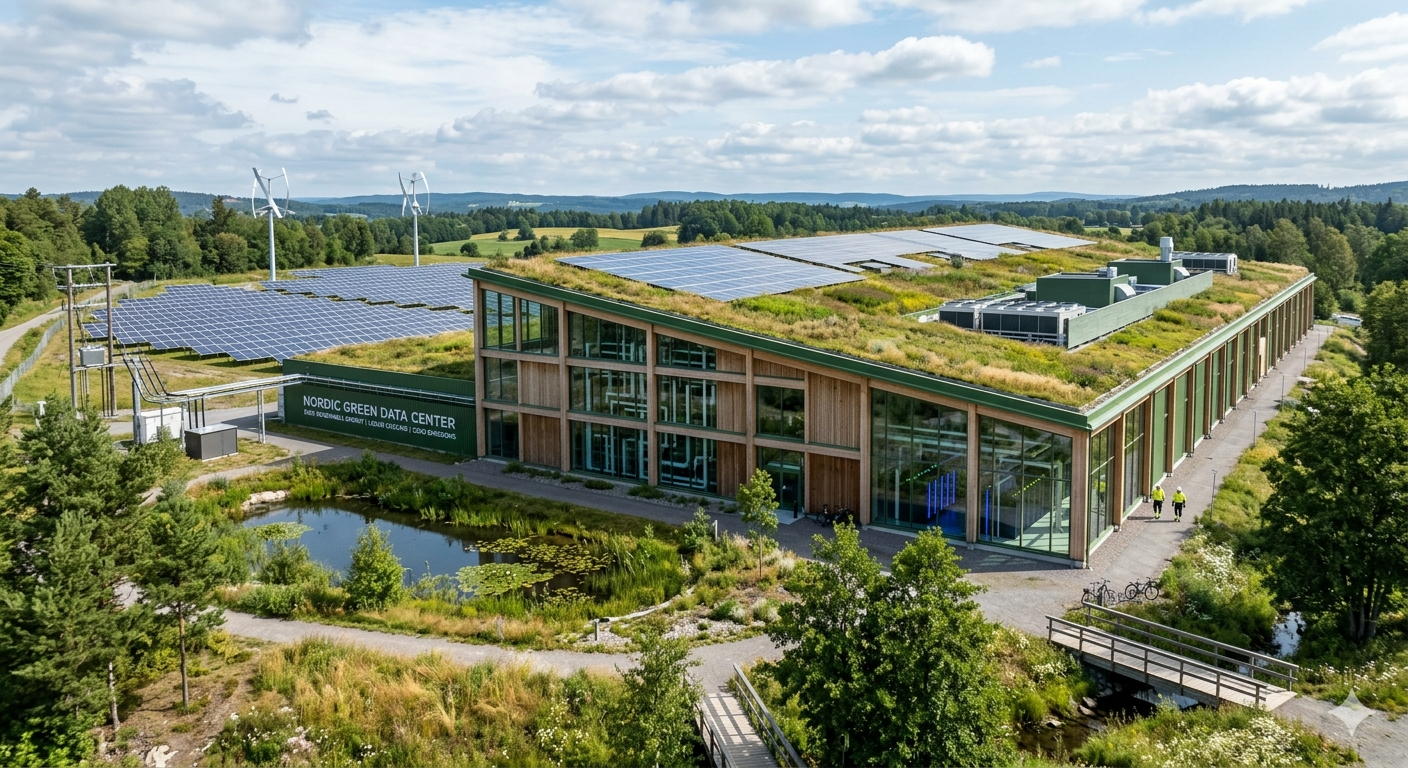
Major operators are pursuing renewable energy through three channels: on-site generation (solar arrays, fuel cells), Power Purchase Agreements (PPAs) with off-site renewable generators, and Renewable Energy Credits (RECs). AECR professionals contribute through roof and site design that maximises on-site generation potential, and grid connection strategies that support time-shifting of non-urgent computing to periods of high renewable availability.
Modular and Scalable Design
Modular data centre design — prefabricated power and cooling modules deployed incrementally — reduces both construction waste and the risk of over-building capacity. From a sustainability perspective, building only what is needed, when it is needed, is a fundamental principle. Architects and structural engineers are central to designing the flexible frameworks that modular deployment requires.
Biodiversity and Site Management
As data centres encroach on greenfield land — often at the urban fringe or in rural areas with good grid access — biodiversity impact is increasingly part of the ESG conversation. Actions such as native vegetation planting, habitat restoration, and rainwater recycling systems are becoming recognised value-adds. GRESB, the real estate ESG benchmarking organisation, identifies biodiversity as a key trend for data centre assets from 2025 onward.
Section 5: ESG, Compliance, and the Investment Angle
Data centres are increasingly viewed not just as operational infrastructure, but as investable real estate assets — and sustainability performance directly affects their valuation and bankability.
The EU Taxonomy defines what qualifies as environmentally sustainable economic activity. For data centres to qualify, they must meet specific operational thresholds — including compliance with the EU Code of Conduct for Data Centres, Climate Risk Vulnerability Assessments (CRVA), and Global Warming Potential (GWP) calculations for refrigerants.
The Corporate Sustainability Reporting Directive (CSRD) mandates Scope 1 and 2 emissions disclosure for large organisations — with Scope 3 expectations growing. For data centre owners and investors, this means robust metering, verified third-party sustainability reporting (through EcoVadis, CDP, or ISO 14001), and credible net-zero transition pathways.
The commercial logic is compelling: data centres with strong sustainability credentials attract larger tenant pools, qualify for green debt instruments, meet institutional investor ESG mandates, and are better positioned for regulatory compliance as frameworks tighten. Conversely, facilities built to minimum compliance today may face stranded asset risk within a decade.
Section 6: What This Means for the Middle East and Global South
The Gulf Cooperation Council (GCC) and broader Middle East are emerging as significant data centre markets. The UAE and Saudi Arabia are investing heavily in digital infrastructure to support their respective national AI strategies, and hyperscale operators are establishing regional presences in Dubai, Abu Dhabi, and Riyadh.
The climate context creates unique AECR challenges. Cooling in ambient temperatures regularly exceeding 45°C requires fundamentally different engineering solutions than temperate-climate data centres. Water scarcity makes WUE a particularly critical metric. And the regional electricity grid, while increasingly fed by solar and nuclear capacity, carries its own carbon intensity profile.
At the same time, the GCC presents genuine opportunities: abundant solar resources for on-site renewable generation, proximity to subsea cable landing stations, and government-backed sustainability mandates — such as UAE Net Zero 2050 and Saudi Vision 2030’s green infrastructure commitments — that are driving demand for sustainable built assets.
For AECR practitioners operating in this region, the UNEP guidelines, LEED, and BREEAM frameworks all apply — and international investors increasingly require compliance as a condition of capital.
Conclusion: The Sustainable Data Centre Is Not Optional
The data centre is one of the defining building typologies of our era. Like the factory in the industrial age or the office tower in the post-war boom, it embodies the economic logic of its time — and inherits the environmental responsibilities that come with scale.
The convergence of AI-driven demand, capital market ESG requirements, and tightening global regulation means that sustainability in data centre design and construction is no longer a premium add-on. It is the baseline expectation — and the frameworks to deliver it now exist, from the UN to the local planning authority.
For architects, engineers, developers, and consultants in the AECR sector, fluency in these guidelines — PUE targets, LEED data centre pathways, EU Code of Conduct best practices, UNEP procurement criteria — is rapidly becoming a professional prerequisite. The firms and professionals who develop this expertise now will be best positioned to serve one of the most significant construction programmes of the coming decade.
Related Articles
- Data Centre Design: Guidelines and Best Practices — Architecture, cooling systems, connectivity, security protocols, and compliance standards for data centre design professionals.
Green Arch World publishes thought leadership on architecture, engineering, construction, and real estate (AECR). Visit greenarchworld.com for more.