
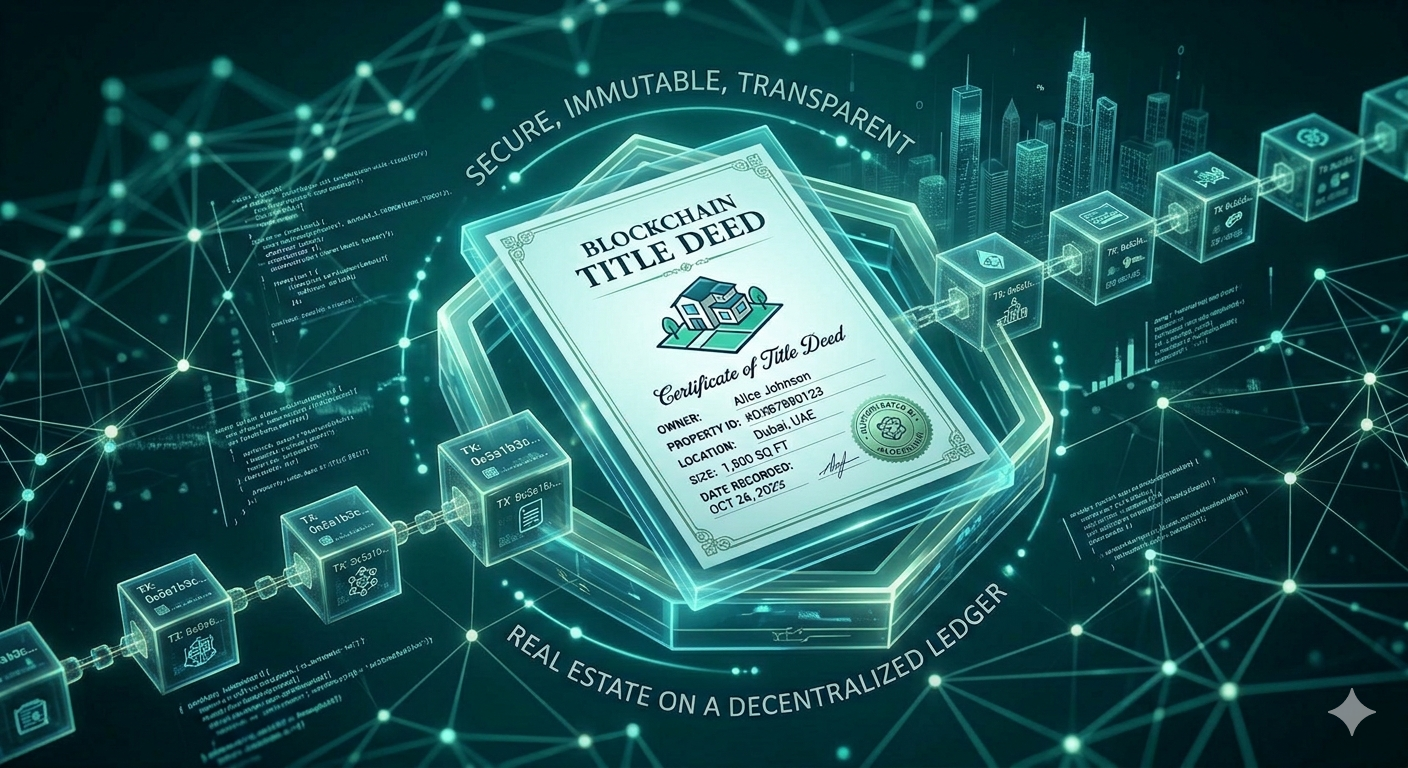
Introduction: Why Property Ownership Needs a Blockchain Layer
Every year, billions of dollars in real estate are lost to title fraud, forged deeds, double-selling schemes and opaque ownership chains. In the United States alone, the title insurance industry handles roughly US$15–20 billion in annual premiums — a cost born almost entirely by buyers and lenders to hedge against a risk that, in a well-functioning registry, should not exist. In developing economies the problem is more existential: the World Bank estimates that 70% of the world’s population lacks legally secure tenure over the land they occupy, leaving trillions of dollars in “dead capital” — property that cannot be pledged, sold or financed because no trusted record exists.
The traditional title system has three structural weaknesses. First, it is fragmented: ownership records live in siloed paper archives, municipal databases and notary offices that rarely communicate with one another, creating gaps that fraudsters exploit. Second, it is slow: a standard conveyance in England takes three to six months; in parts of Asia, Africa and Latin America, registration can take years. Third, it is opaque: foreign investors, institutional funds and cross-border financiers often cannot independently verify encumbrances, liens or ownership history without engaging local intermediaries — adding cost, time and counterparty risk.
Blockchain addresses all three weaknesses simultaneously. By recording title events on a distributed ledger that is shared, append-only and cryptographically tamper-evident, it creates a single version of property truth that no single party can unilaterally alter. Smart contracts can automate the conditional logic of conveyancing — releasing funds only when KYC clears, transferring the deed only when stamp duty is settled — compressing weeks of manual coordination into minutes of code execution. And tokenization converts illiquid bricks-and-mortar into programmable digital assets that can be traded, pledged and fractionalized across borders at near-zero cost.
The benefits are quantifiable. Goldman Sachs has estimated US$2–4 billion in potential annual savings from blockchain in U.S. title insurance alone. Sweden’s land registry pilot projected €100 million per year in administrative savings. Dubai — the world’s most advanced live deployment — has set a target of AED 60 billion (~US$16 billion) in tokenized real estate transactions by 2033, representing 7% of all Dubai real estate activity. And Deloitte forecasts the global tokenized real estate market will grow from roughly US$0.3 trillion in 2024 to US$4 trillion by 2035, a compounded annual growth rate of 27%.
For architecture, engineering, construction and real estate (AECR) professionals, this is not a distant fintech experiment. It is a structural shift in how property is recorded, financed and traded — one that is already live in Dubai, operational across Indian states, and embedded in Estonia’s national digital infrastructure. The question is no longer whether blockchain will transform property ownership. It is which jurisdictions will lead, which will stall, and what separates them.
This article examines the global state of blockchain title deeds — country by country, benefit by benefit, barrier by barrier — to provide AECR professionals with the clearest possible picture of where the transformation stands today and where it is heading.
How Blockchain Title Deeds Actually Work
Strip away the jargon and a blockchain title deed is a four-layer construct:
- Distributed ledger — a shared, append-only database replicated across multiple authorised nodes (banks, notaries, the registry, sometimes the public). No single party can unilaterally rewrite history.
- Cryptographic immutability — each new entry (a transfer, mortgage, lien) is hashed and chained to the previous one. Tampering with any record breaks every subsequent hash, making forgery mathematically detectable.
- Smart contracts — self-executing code that performs conditional logic: release escrow only when funds clear; transfer the deed token only when KYC passes; auto-settle stamp duty. No manual chasing of solicitors required.
- Tokenization — the deed (or a fractional share of it) is represented as a unique digital token (often an NFT or permissioned equivalent) that can be traded, pledged or programmed.
In practice, three architectures dominate. Permissioned ledgers (Sweden’s ChromaWay/Postchain, the UK’s Corda, Dubai’s internal stack until 2025) are run by trusted entities and offer privacy and throughput. Public-blockchain anchoring (Georgia’s Bitfury/Exonum approach; Estonia’s KSI hash-timestamping) keeps the registry off-chain but anchors cryptographic proofs to a public chain — a low-risk hybrid that adds tamper-evidence without exposing sensitive data. Public-chain native tokenization (Dubai’s 2025 XRP Ledger deployment; Propy’s Ethereum NFT sales) places the actual ownership token on a public network, maximising transparency and composability but creating sharper legal and privacy questions.
One critical point for AECR professionals: blockchain does not verify whether the underlying real-world fact is correct — it only guarantees that whatever was written has not been altered. This is the oracle problem, and it is why every successful registry from Tbilisi to Dubai retains a human-supervised data-entry gateway. Blockchain eliminates post-entry tampering; it does not eliminate pre-entry error or fraud.
Global Case Studies
United Arab Emirates (Dubai) — From Pilot to Production
Dubai is the world’s most advanced live deployment of blockchain in real estate. The Dubai Land Department (DLD) became the first government real estate authority to publicly adopt blockchain in October 2017, integrating it with Ejari (rental contracts), DEWA (utilities), and Emirates NBD payments. By March 2024, only digital, blockchain-anchored title deeds were being issued — physical paper deeds were eliminated entirely.
In May 2025, the DLD — with VARA, the Dubai Future Foundation, fintech Prypco and infrastructure provider Ctrl Alt — went live with native tokenization on the XRP Ledger. The Prypco Mint platform allows UAE-ID holders to acquire fractional ownership from AED 2,000 (~US$540), with the explicit government target of AED 60 billion (US$16 billion) in tokenized real estate by 2033. The Dubai REST app, initially launched as an inquiry tool in 2017, now supports the bulk of non-developer transactions and provides end-to-end digital property management.
Republic of Georgia — The Longest-Running Live Deployment
In partnership with Bitfury and economist Hernando de Soto, Georgia’s National Agency of Public Registry (NAPR) launched the world’s first national blockchain land registry in April 2016. Using Exonum, NAPR hashes each property record and timestamps the proof to the Bitcoin blockchain — preserving the existing user interface while adding a tamper-evident layer. By 2018 the system had registered approximately 1.5 million property entries, covering purchases, mortgages, demolitions and notary services. In early 2025, NAPR added a smart-contract layer for cross-border transactions.
An important nuance: independent analysis by the U4 Anti-Corruption Centre notes that public-trust gains came largely from administrative reform that preceded blockchain. This is a critical lesson for any jurisdiction considering replication — the technology amplifies a working system; it cannot rescue a broken one.
Estonia — Quiet, Foundational, Effective
Estonia’s KSI Blockchain (developed by Guardtime, embedded in the e-Estonia X-Road framework) underpins the e-Land Register, e-Health, e-Court, the State Gazette and the Business Register. It does not store deeds on-chain; it timestamps and hashes them. Coupled with mandatory digital identity (eID, Mobile-ID, Smart-ID), Estonia has compressed property registration from roughly three months to about one week — and remains the European model most often cited by EU policymakers under the European Blockchain Services Infrastructure (EBSI).
Sweden — Technically Ready, Legally Stuck
Lantmäteriet, ChromaWay, SBAB Bank, Landshypotek, Telia and Kairos Future ran one of the most technically rigorous pilots in the world (2016–2018), demonstrating end-to-end smart-contract conveyancing on Postchain. Kairos Future estimated annual savings of over €100 million and a reduction of contract-to-registration time from three to six months down to a few days or hours. Yet the project never reached production. The primary blockers: the unsettled legal status of digital signatures on real property contracts, and resistance from intermediaries — brokers and bankers — whose informational rents the system would have stripped away.
United Kingdom — Methodical and Unfinished
HM Land Registry’s “Digital Street” project (launched 2017) used R3’s Corda platform and partners including Methods, Mishcon de Reya, Yoti and Shieldpay. In a 2019 demonstration, a 22-week conveyance in Gillingham, Kent, was replicated end-to-end on the prototype in under 10 minutes. A subsequent ConsenSys-Codefi proof-of-concept built a tokenized title on Ethereum. Both remain experimental. HMLR has prioritised comprehensive digital registration workflows over blockchain rollout.
United States — A County-Level Mosaic
The U.S. has no federal blockchain land registry initiative. Progress is county-by-county:
- Cook County, Illinois (2016–2017): The first government-sanctioned U.S. blockchain title-transfer pilot, run with Velox.RE on Bitcoin. The final report concluded that legal conveyance and recording remained two distinct acts under Illinois law, requiring a paper “Confirmation Deed” backstop.
- South Burlington, Vermont (Propy, 2018): The first government-recorded blockchain real estate deed in the United States. Vermont’s legislation granting blockchain records a presumption of admissibility was the decisive enabler.
- Teton County, Wyoming (Medici Land Governance, 2019): The first U.S. county to register all post-1996 land records on blockchain. Carbon County, Wyoming followed in 2020; Baltimore began a pilot for 14,000 vacant properties.
- Propy NFT sales (2022): A Gulfport, Florida home sold for 210 ETH (~US$653,000) with ownership transferred via an LLC wrapper whose membership interest was an NFT — a legal workaround to U.S. recording requirements that avoids replacing the deed itself.
India — Federal Patience, State-Level Acceleration
Andhra Pradesh became the first Indian state to adopt blockchain in governance, partnering with ChromaWay and Zebi to secure over 100,000 land records in the Amaravati capital region from 2017 onward. Telangana, Maharashtra, Karnataka, Odisha, Tamil Nadu and Uttar Pradesh have all run pilots. In March 2024, the Dantewada district of Chhattisgarh, with Zupple Labs’ LegitDoc on Avalanche, digitized approximately 700,000 land records dating to the 1950s, reducing verification from weeks to minutes. India’s National Blockchain Framework had authenticated approximately 340 million government records by October 2025, and the city of Amravati (Maharashtra) announced a Polygon-based migration of all municipal land, property and tax records in 2025.
Ghana and Africa — Promise, Plateau, and the Kleptocracy Ceiling
Bitland launched in Kumasi in 2015–2016, attempting to register parcels in Ghana’s 78% unregistered land base via GPS surveys and Bitshares-based cadastral tokens. The project demonstrated technical feasibility but never displaced customary tenure systems or secured durable government endorsement. Similar fates met Factom’s Honduras initiative (2015) and several Rwandan, Tanzanian and Zambian pilots. The consistent lesson: in jurisdictions with weak rule-of-law foundations and absent cadastral data, blockchain reproduces the underlying disorder rather than fixing it.
Comparative Analysis: What Worked, What Stalled
Three variables consistently separate live deployments from stalled pilots:
Legal Recognition of Digital Signatures
Every jurisdiction with a live system — Dubai, Georgia, Estonia, Indian states — had either pre-existing digital-signature legislation or rapidly enacted it. Every stalled system — Sweden, Honduras, the UK — entered the pilot with unresolved legal questions about the evidentiary weight of electronic property records.
Quality of the Underlying Cadastre
Blockchain succeeds where it acts as a thin layer of trust on top of a working registry, not as a wholesale replacement. Georgia ranked in the World Bank’s top tier globally for ease of property registration before its blockchain layer was added. Dubai’s registry was already fully digital. India’s successful state pilots had prior digitisation programmes in place. Bitland (Ghana) and Factom (Honduras) attempted to build the registry and the blockchain simultaneously — and neither succeeded.
Sustained Political Sponsorship
Dubai’s blockchain mandate comes from the top of government (the Smart Dubai initiative under Sheikh Hamdan); Estonia’s e-government programme has survived multiple elections as a matter of national identity; Georgia’s NAPR reform was backed by post-Rose Revolution political will. Agency-led projects in Sweden and the UK proved vulnerable to changes in ministerial priority and institutional resistance from incumbents whose rents the technology threatened.
Key Benefits — The Quantified Case
- Fraud elimination: Goldman Sachs estimated US$2–4 billion in potential annual savings from blockchain in U.S. title insurance alone, where approximately 30% of losses are fraud-related.
- Speed: Sweden’s pilot showed conveyancing collapsing from 3–6 months to days; HMLR’s prototype demonstrated end-to-end transfer in under 10 minutes; Estonia operates at roughly one week vs. three months previously.
- Cost reduction: Lantmäteriet/Kairos Future projected €100 million/year in Swedish administrative savings; tokenization platforms like Prypco Mint aim to reduce real estate entry thresholds from ~US$250,000 to as low as US$540.
- Transparency for cross-border investors: Public on-chain provenance reduces information asymmetry — critical for sovereign-wealth funds, family offices and cross-border institutional capital.
- Fractional ownership and democratised access: Deloitte estimates tokenization can lower retail real estate entry from ~US$250,000 to as low as US$1,000, opening the asset class to a far wider investor base.
- Programmable compliance: Smart contracts can enforce residency rules, sanctions screening and AML requirements at the protocol level, reducing regulatory burden on intermediaries.
Challenges and Risks — The Honest Assessment
Legal Recognition
No major jurisdiction yet permits a pure blockchain token transfer to replace a registry deed update. Even Vermont’s pioneering pilot relied on a parallel paper Confirmation Deed. Until property statutes are amended globally, blockchain remains an evidentiary supplement — not a substitute — for conventional registration.
The Oracle Problem
Blockchain perfectly preserves whatever data is loaded — including fraudulent or erroneous data. Every registry depends on the integrity of the data-entry process. Corruption or error at the human gateway is propagated faithfully, not eliminated. Blockchain moves the attack surface from post-entry tampering to pre-entry manipulation.
Cyber and Key-Management Risk
Loss of a private key can be functionally equivalent to loss of title. Custodial models (UAE Pass, Estonian eID) mitigate this but reintroduce a degree of centralised trust. Multi-party key custody and recovery protocols are still maturing.
Privacy Exposure
Property records contain identity, mortgage values and family wealth. Public chains expose these unless paired with zero-knowledge or hash-only architectures. GDPR and similar regimes create compliance friction for public-chain deployments in the EU.
Incumbent Resistance
The U.S. title-insurance industry alone is a ~US$20 billion business; notary and conveyancing professions worldwide represent comparable rents. These incumbents have institutional influence over the regulators and legislators who must enable blockchain registries — and they have shown willingness to use it.
Regulatory Classification of Tokens
Tokenized property interests can be classified as securities, currencies, derivatives or none of the above, depending on structure and jurisdiction — creating planning risk for issuers and investors. EU MiCA, UAE VARA and the U.S. SEC’s evolving stance each impose different constraints.
Current Status: 2024–2025 Snapshot
Live and operational: UAE/Dubai (paperless title deeds since March 2024; tokenization pilot live since May 2025 on the XRP Ledger); Republic of Georgia (continuous since 2016, smart-contract layer added in 2025); Estonia (KSI-anchored e-Land Register, continuous since mid-2010s); India (state-level live deployments in Andhra Pradesh, Telangana, Chhattisgarh).
Active limited deployments: Wyoming (Teton, Carbon Counties via Medici Land Governance); Vermont (South Burlington via Propy); Baltimore (vacant-property pilot).
Stalled or sub-scale: Honduras (Factom partnership effectively dormant); Ghana Bitland (demonstrator scale only); UK Digital Street (no production rollout announced after seven years); Sweden (no move beyond proof-of-concept despite a decade of work).
Key regulatory milestones: EU MiCA fully applicable since 2024–2025; EU DLT Pilot Regime in force since March 2023; UAE VARA framework providing a clear sandbox for tokenized real estate; U.S. January 2025 executive order on digital financial technology; UK 2024 fund-tokenization roadmap.
The Road Ahead: 2025–2035
Three trajectories are converging.
Tokenized Real Estate as a Mainstream Asset Class
Deloitte forecasts US$4 trillion in tokenized real estate by 2035 (CAGR 27%); BCG projects US$3.2 trillion by 2030. As of mid-2024, 12% of global real estate firms had already implemented some form of tokenization, with another 46% piloting. BlackRock’s BUIDL tokenized fund surpassed US$462 million in 2024; Kin Capital closed a US$100 million tokenized debt fund on Chintai. Institutional capital is arriving at the same infrastructure that Dubai is deploying for deed-level tokenization.
Title Deeds and Digital Identity Converge
UAE Pass, Estonian eID, India Stack, EU eIDAS 2.0 wallets and Singapore’s Singpass each provide the identity rail that blockchain registries require. The near-term frontier is “title tokens that know who you are” — programmable deeds that enforce residency rules, sanctions screening and AML compliance at the protocol level, without human intermediaries.
Interoperability Between National Registries
Cross-border collateralisation — pledging a Dubai-tokenized villa as collateral to a Frankfurt bank without a paper trail — is likely the first killer use case before fully cross-border deed transfer. SWIFT–Chainlink cross-chain settlement work and the EU EBSI framework are early infrastructure steps in this direction.
For AECR developers, asset managers and institutional investors, the strategic imperatives are clear: budget for digital-twin metadata at the design stage; structure SPVs to be tokenization-ready; demand title-history APIs from registry counterparties; and treat blockchain literacy in legal and finance teams as table stakes by 2027.
The deed as a paper document is already obsolete in Dubai. For the rest of the world, the question is timing, not direction.
Published by Green Arch World — thought leadership in architecture, engineering, construction and real estate.