The UAE’s skyline is more than glass and ambition — it is increasingly a statement about sustainability. As the country races toward its Net Zero 2050 target and Dubai executes its 2040 Urban Master Plan, green building certifications have moved from optional differentiators to near-mandatory requirements for any serious real estate project.
For developers, investors, and project teams operating in the UAE, understanding the certification landscape is no longer a niche concern. It is a commercial imperative. Certified green buildings in Dubai command 10–20% higher rental yields and 5–8% price premiums, and sustainable properties are projected to account for 35% of total Dubai transactions by 2025, up from just 15% in 2020.
This guide breaks down every major certification available to UAE real estate projects — what each measures, who governs it, and where it fits in your development strategy.
Why Certifications Matter in the UAE Context
The UAE is a desert nation where buildings account for over 85% of electricity consumption in cities like Dubai. That single fact explains the urgency behind the regulatory push.
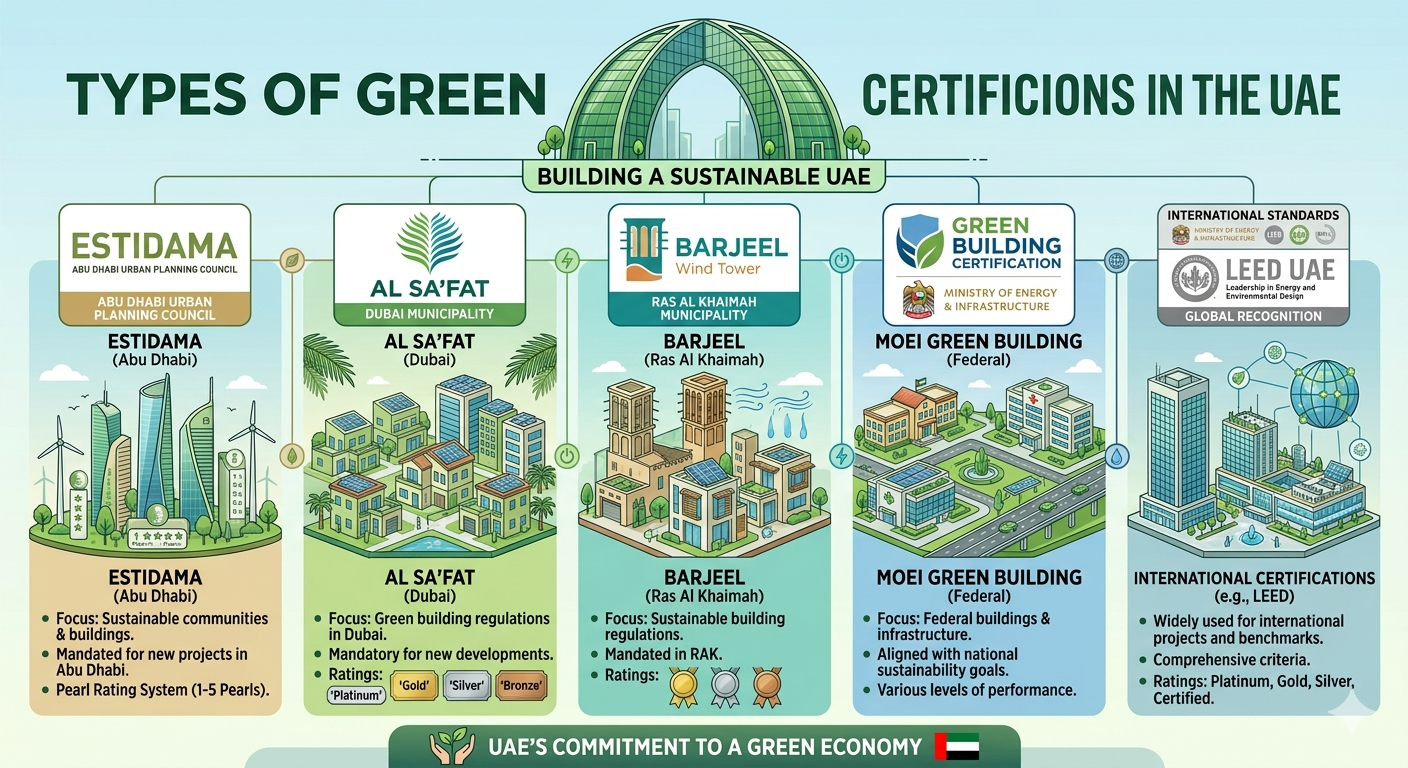
Since 2011, Dubai has mandated green building compliance for government buildings, and since 2014 for all new buildings. Abu Dhabi has similarly enforced minimum Pearl ratings under Estidama for all new construction. By 2025, Federal Decree Law No. 11 makes climate action plans mandatory for developers and construction firms, with penalties running into millions of dirhams for non-compliance.
Against this backdrop, there are now seven major certification frameworks relevant to UAE projects. Some are locally developed; others are internationally recognised systems adopted widely across the region.
1. Al Sa’fat — Dubai’s Mandatory Green Rating System
Governing body: Dubai Municipality
Scope: All new buildings in Dubai, including free zones
Applicable since: 2016 (latest edition: January 2023)
Al Sa’fat — the Arabic plural of palm tree leaves — is Dubai’s own green building rating system. Unlike most international frameworks, it is not optional. Every new development requiring a building permit in Dubai must achieve at minimum the Silver Sa’fa level.
Rating Levels
| Level | Description |
|---|---|
| Bronze | Baseline compliance |
| Silver | Mandatory minimum for all new buildings |
| Gold | Enhanced performance — voluntary |
| Platinum | Highest tier — voluntary |
What It Evaluates
Al Sa’fat is structured around six core categories plus a bonus innovation category:
- Energy and Atmosphere — the single largest category, accounting for 43% of the total score, reflecting Dubai’s acute cooling and energy demands
- Water Efficiency — low-flow fixtures, greywater recycling, smart irrigation
- Materials and Resources — recycled, bio-based, and regionally sourced materials
- Indoor Environmental Quality (IEQ) — air quality, lighting, acoustics
- Ecology and Planning — urban heat island mitigation, landscaping, building orientation
- Innovation and Smart Technologies — bonus category for forward-looking design
Why It Stands Out
Al Sa’fat is not a point-based system like LEED. A building must meet all requirements at a given tier to be certified at that level — making partial compliance irrelevant. This all-or-nothing approach raises the floor for all developments.
Since its adoption, Al Sa’fat has contributed to reducing carbon emissions by approximately 2.28 million metric tons, with energy and water consumption reductions of up to 35% in higher-tier certified buildings. Over 55,000 buildings in Dubai are already applying Al Sa’fat standards. Source: Property Finder — Dubai Green Building Regulations Guide.
2. Estidama Pearl Rating System — Abu Dhabi’s Homegrown Standard
Governing body: Abu Dhabi Urban Planning Council (UPC)
Scope: All building typologies in Abu Dhabi
Mandatory minimum: 1 Pearl for all new buildings; 2 Pearls for government projects
Estidama — meaning “sustainability” in Arabic — was developed specifically for Abu Dhabi’s climate, culture, and urban context. It is one of the most regionally nuanced green building frameworks in the world, designed to reflect the realities of desert living rather than simply transplanting Northern European or North American standards.
Rating Levels
The system awards buildings from 1 Pearl (minimum compliance) to 5 Pearls (world-class performance).
What It Evaluates
- Energy efficiency and performance
- Water conservation — given special emphasis given the UAE’s acute freshwater scarcity
- Sustainable materials selection
- Indoor environmental quality
- Site planning and ecology
- Cultural and community considerations — unique among global certification systems
Estidama’s equal weighting of water alongside energy is a deliberate design choice that distinguishes it from LEED and BREEAM. Pearl-rated properties typically cut energy bills by 25%. Abu Dhabi’s Masdar City was developed with Estidama as its foundational framework — one of the world’s most ambitious sustainability implementations. Source: Construction Week Online — Green Building Certifications Deep Dive.
3. LEED — The Global Standard, Deeply Embedded in UAE
Governing body: U.S. Green Building Council (USGBC)
Scope: International — widely used across UAE
Status in UAE: Voluntary, but highly prevalent
LEED (Leadership in Energy and Environmental Design) is the world’s most widely adopted green building certification, and the UAE has embraced it at scale. As of 2024, Dubai alone has over 400 LEED-certified buildings, with expectations to surpass 500. The UAE and Saudi Arabia now rank among the top 10 global green building markets partly on the strength of LEED adoption. Source: Unique Properties — Dubai Sustainable Real Estate.
Rating Levels
| Level | Points Required |
|---|---|
| Certified | 40–49 |
| Silver | 50–59 |
| Gold | 60–79 |
| Platinum | 80+ |
What It Evaluates
LEED assesses buildings across a point-based scorecard covering Sustainable Sites (the highest-weighted category), Water Efficiency, Energy and Atmosphere, Materials and Resources, Indoor Environmental Quality, Innovation in Design, and Regional Priority Credits specific to local context.
Why Developers in the UAE Pursue LEED
For developers with cross-border investor bases — particularly those targeting European, North American, or institutional capital — LEED carries unmatched brand recognition. LEED-certified buildings reduce operational costs and command premium rents from multinational corporate tenants who require certified space as part of their own ESG commitments.
4. BREEAM — The British Standard With Growing UAE Presence
Governing body: Building Research Establishment (BRE), UK
Scope: International — growing adoption in Dubai and Abu Dhabi
Status in UAE: Voluntary
BREEAM (Building Research Establishment Environmental Assessment Method) is the world’s longest-standing green building certification, originating in the UK in 1990. In the UAE, it is favoured particularly by developers targeting European markets or working on mixed-use and commercial developments in areas like Jumeirah Village Circle and Business Bay.
Rating Levels
| Score | Rating |
|---|---|
| Below 30% | Unclassified |
| 30%+ | Pass |
| 45%+ | Good |
| 55%+ | Very Good |
| 70%+ | Excellent |
| 85%+ | Outstanding |
What It Evaluates
BREEAM’s ten categories are notably broad: Energy, Water, Health and Wellbeing, Materials, Waste, Land Use and Ecology, Pollution, Transport, Management, and Innovation. BREEAM places particular weight on transport connectivity and ecological impact — categories that are underweighted in more energy-focused systems like Al Sa’fat.
BREEAM-certified buildings in Dubai achieve 10–15% higher resale values due to global recognition, and rigorous standards reduce operational costs by approximately 25%. Source: CW Property — Top Green Building Certifications in UAE.
5. WELL Building Standard — Where Sustainability Meets Human Health
Governing body: International WELL Building Institute (IWBI)
Scope: International — growing UAE adoption
Focus: Occupant health and wellbeing, not just environmental performance
WELL is the only major certification that puts human health at the centre of its framework, rather than environmental metrics. As the UAE’s residential and commercial market matures, and as large corporates increasingly commit to employee wellbeing, WELL is gaining serious traction — particularly in Dubai’s DIFC, Business Bay, and Downtown corridors.
What It Evaluates
WELL certification assesses buildings across ten concepts: Air, Water, Nourishment, Light, Movement, Thermal Comfort, Sound, Materials, Mind, and Community. The framework directly addresses factors like circadian lighting, indoor air quality, acoustic performance, biophilic design, and access to healthy food — elements that resonate with both premium residential buyers and institutional corporate tenants.
In a market where expatriates and high-net-worth tenants demand premium living environments, WELL certification provides a compelling differentiator. Residential developers are increasingly using WELL to position wellness-focused communities alongside environmental credentials. Source: Construction Week Online — Green Building Certifications Deep Dive.
6. GSAS — The GCC’s Own Regional Framework
Governing body: Gulf Organisation for Research and Development (GORD)
Full name: Global Sustainability Assessment System
Scope: Developed for the GCC — used in Qatar, Saudi Arabia, and UAE
Status in UAE: Voluntary
GSAS was developed specifically for the Gulf climate and context, making it highly relevant for UAE projects — particularly those with cross-GCC footprints. It is the mandatory standard in Qatar and a key framework for major Saudi projects, and its regional credibility is growing steadily.
What It Evaluates
GSAS assesses buildings primarily on energy and site measures, with categories including Energy, Water, Indoor Environment, Site, Materials, and Cultural and Economic Value. Its strong prioritisation of energy and site measures reflects Gulf-specific climate realities, though it gives comparatively less weight to water and waste than Estidama or LEED.
For UAE developers with portfolio exposure across the GCC — particularly in Qatar and the KSA — GSAS provides a unified framework that travels across borders and aligns with the UAE’s Net Zero 2050 goals. Source: Estate Magazine — 7 Green Building Certifications Boosting Value in 2025.
7. EDGE — The Fast-Track Certification for Emerging Markets
Governing body: International Finance Corporation (IFC), a World Bank Group member
Full name: Excellence in Design for Greater Efficiencies
Scope: International — designed for high-growth markets
Status in UAE: Voluntary
EDGE was created by the IFC to make green building certification accessible, fast, and cost-effective — particularly for mid-market and affordable housing developments where the cost premium of LEED or BREEAM may be prohibitive. It is increasingly relevant for UAE developers working in the Northern Emirates or targeting value-oriented residential segments.
The 20-20-20 Framework
EDGE focuses on three primary performance pillars, each with a minimum 20% improvement over baseline:
- Energy savings — minimum 20% reduction vs. baseline
- Water savings — minimum 20% reduction vs. baseline
- Embodied energy in materials — minimum 20% reduction in the energy embedded in construction materials
EDGE is particularly useful for unlocking green financing. Multiple UAE banks — including First Abu Dhabi Bank, which signed an MoU with the Ministry of Energy and Infrastructure specifically around green building financing — offer preferential rates for EDGE-certified projects. It is the easiest pathway to green certification for smaller and mid-market developers.
8. National Green Certificates Program — The Federal Framework
Governing body: UAE Ministry of Energy and Infrastructure (MoEI)
Scope: Federal — all UAE emirates
Launched: 2024
The National Green Certificates Program is the UAE’s newest and most significant framework — a federal-level initiative designed to provide a unified baseline for all commercial buildings across all seven emirates. Unlike the emirate-specific systems (Al Sa’fat, Estidama), this program operates at the national level, harmonising what has previously been a fragmented landscape.
What It Covers
The program sets specific standards for energy efficiency classification, water management, indoor air quality, and the use of sustainable building materials. MoEI provides technical support and consultancy for participating businesses. Crucially, the program is linked to green finance mechanisms, with MoUs signed with First Abu Dhabi Bank and other financial institutions to channel preferential financing toward certified developments.
For developers operating across multiple emirates, the National Green Certificates Program will increasingly become the common compliance thread. It signals the direction of travel for UAE real estate regulation at the highest level.
Choosing the Right Certification: A Strategic Framework
No two projects are identical. The right certification depends on building type, geographic location, investor audience, budget, and long-term strategy.
| Certification | Origin | Mandatory in UAE? | Primary Strength | Best For |
|---|---|---|---|---|
| Al Sa’fat | Dubai Municipality | Yes (Dubai) | Energy efficiency, local compliance | All Dubai developments |
| Estidama | Abu Dhabi UPC | Yes (Abu Dhabi) | Water + energy + cultural context | All Abu Dhabi developments |
| LEED | US (USGBC) | No | Global brand recognition | International investors, commercial |
| BREEAM | UK (BRE) | No | Broad sustainability + transport | European investors, mixed-use |
| WELL | International (IWBI) | No | Human health and wellbeing | Premium residential, corporate offices |
| GSAS | GCC (GORD) | No | GCC-specific, cross-border | GCC portfolio developers |
| EDGE | IFC / World Bank | No | Cost-effective, green finance access | Mid-market, affordable housing |
| National Green Certs | UAE Federal (MoEI) | Emerging | Federal harmonisation | All emirates, future compliance |
The Financial Case — Numbers That Matter
The business case for green certification in the UAE has never been clearer:
- Green-certified buildings command 10–20% higher rental yields and 5–8% price premiums
- Sustainable properties are on track to represent 35% of Dubai transactions by end of 2025 — up from 15% in 2020
- Al Sa’fat compliance has delivered energy and water consumption reductions of up to 35% in higher-tier buildings
- LEED and BREEAM certified buildings reduce operational costs by approximately 25%
- Pearl-rated properties under Estidama cut energy bills by 25% on average
- Green-certified buildings attract higher-quality tenants, lower vacancy rates, and longer lease terms
Beyond operational savings, green certifications are increasingly a gateway to preferential financing. Multiple UAE banks now offer green mortgage and construction financing products, with certification serving as the qualifying criterion. Source: Money Maestro — The Rise of Sustainable Real Estate in the UAE.
The Regulatory Direction of Travel
The policy trajectory in the UAE is unambiguous. Mandatory requirements are increasing, not decreasing. Key milestones ahead include:
- Federal Decree Law No. 11 making climate action plans mandatory for all developers and construction firms
- The National Green Certificates Program expanding its reach to all commercial buildings across all emirates
- Dubai’s Energy & Water Demand Management Strategy targeting 30% savings by 2030 and 50% savings by 2050
- Increasing integration of ESG reporting requirements for listed real estate companies and major institutional developers
For developers and investors, the question is no longer whether to pursue green certification — it is which certifications to prioritise, and how to build them into project economics from day one. Further reading on the UAE’s regulatory framework is available from the Emirates Green Building Council and the broader sustainable real estate development landscape.
Final Thought
The UAE’s green building landscape is one of the most active and sophisticated in the world. Local developers now work within a multi-layered ecosystem of mandatory regulations and voluntary certifications, each with its own logic, market positioning, and financial implications.
The best developments in the UAE over the next decade will not just be certified. They will be designed, from the first sketch, around the idea that a building’s relationship with its environment is its most important characteristic.
Green Arch World is a thought leadership platform covering Architecture, Engineering, Construction, and Real Estate (AECR) globally. Visit greenarchworld.com for more insights.