
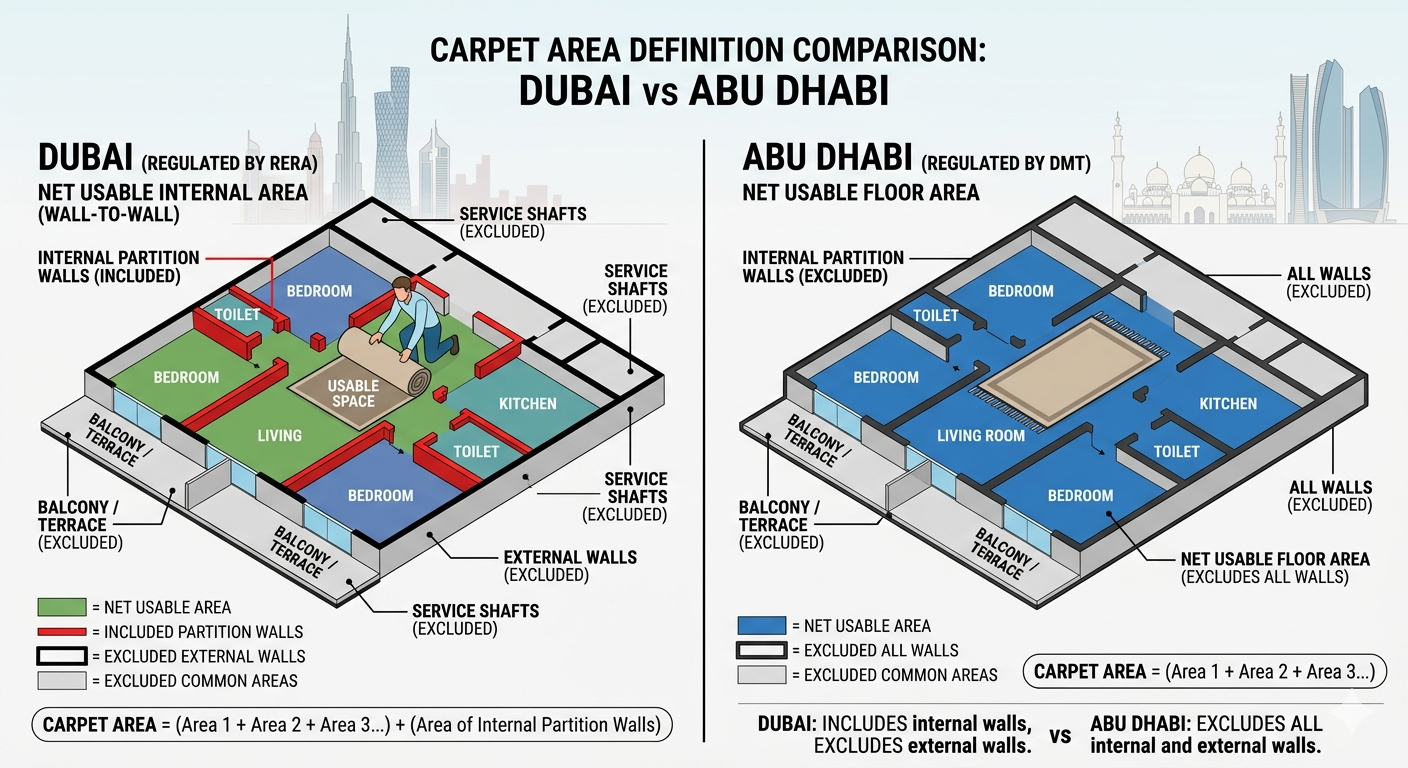
When you buy a 900 sq ft apartment in Downtown Dubai, and then compare it to a 900 sq ft apartment on Reem Island in Abu Dhabi — are you actually comparing the same thing? The short answer is: almost certainly not. And that distinction could be worth tens of thousands of dirhams.
Despite being part of the same country, Dubai and Abu Dhabi operate under entirely different regulatory frameworks when it comes to how property area is defined, measured, and disclosed. For buyers, investors, and professionals operating across both markets, understanding this divergence is not just useful — it is essential.
Why Area Definitions Matter So Much
In real estate, the price you pay is almost always expressed in AED per square foot. This means the definition of what constitutes one square foot of a property directly affects how much you pay, how you value a resale, and how accurately you can calculate your rental yield.
The challenge in the UAE is that there is no single federal standard for how residential area is measured and communicated to buyers. Each emirate sets its own rules — and in the case of Dubai and Abu Dhabi, those rules result in meaningfully different outcomes at the point of purchase.
The Area Hierarchy: Three Terms Every Buyer Must Know
Across both emirates, you will encounter three core area terms. Understanding their relationship is the foundation of everything else.
Built-Up Area (BUA)
BUA is the broadest and largest measurement. It covers the total area being developed or constructed — including the gross floor area, parking, and all service areas associated with the building or project. Developers frequently advertise BUA because it is the biggest number and makes the price-per-sqft appear more attractive to buyers. A property listed at 1,200 sq ft BUA might only offer 950 sq ft of actual livable space.
Gross Floor Area (GFA)
GFA refers to the total enclosed floor area of a building, calculated from the outer face of its external walls. It includes all floors, structural walls, balconies, and covered terraces — but typically excludes parking and underground technical plant areas. In Dubai, GFA is the metric used by the Dubai Land Department (DLD) and Dubai Municipality for regulatory purposes, title deed registration, and floor area ratio (FAR) calculations.
Net Floor Area (NFA) / Carpet Area
NFA — also called “usable area” or “carpet area” in common usage — is the space you actually live in. It strips out everything that is not directly usable: structural cores, fire stairs, lift shafts, plant areas, service risers, façade thickness, and common corridors. It represents the area where you can place furniture, move around, and spend your daily life. In practice, NFA is typically 15–20% smaller than GFA in Dubai’s residential market.
Dubai: A GFA-Led, DLD-Regulated Framework
Dubai has the more codified of the two systems. The Dubai Building Code formally defines BUA, GFA, and NFA as distinct metrics, and ties GFA to Floor Area Ratio limits that govern what developers can build on any given plot. These definitions are enforced through the planning and permitting process via Dubai Municipality, and registered with the DLD at the title deed stage.
For buyers, this creates a specific dynamic: the DLD uses GFA as the standard reference figure for official documentation and title deeds. Developers, however, frequently advertise BUA in their marketing materials because it is the larger number. RERA’s consumer protection rules require developers to register accurate area data, and any material discrepancy between promised and delivered area gives buyers grounds for compensation under Dubai’s off-plan regulations.
What Dubai does not have is a mandatory requirement to price and advertise units based on net usable area (NFA) — the equivalent of what India’s RERA Act 2016 mandates as “carpet area.” In Dubai, the pricing metric (BUA vs. GFA vs. NFA) is ultimately a commercial decision made by the developer, within the regulatory framework set by DLD and RERA.
A practical illustration: a 1,200 sq ft BUA apartment in Dubai Marina may only deliver around 950–1,000 sq ft of actual usable interior space. Many buyers only discover this gap at handover — by which point they have already completed the transaction.
Abu Dhabi: Net Area Convention, Without a Statutory Definition
Abu Dhabi’s property market is regulated by ADREC (Abu Dhabi Real Estate Centre) under the Department of Municipalities and Transport (DMT). The emirate’s building codes — adapted from International Building Codes via the Abu Dhabi Quality and Conformity Council (QCC) — are technically rigorous for construction and planning purposes. However, there is no publicly codified, mandatory consumer-facing definition of “carpet area” or “net area” that developers are required to use uniformly in their Sales and Purchase Agreements (SPAs).
In practice, Abu Dhabi’s major developers — led by Aldar Properties, which accounts for approximately 40% of the emirate’s residential sales value — typically quote and transact on a net area basis. This is actually more favourable to buyers in principle, because the figure is closer to real usable space. However, because the definition of “net area” is not standardised by statute, what is included or excluded from that figure can vary between developers and even between projects from the same developer.
Key variables that different developers in Abu Dhabi may handle differently in their “net area” figure include:
- Whether enclosed balconies are included or excluded
- Whether the thickness of internal partition walls is counted
- How utility ducts and service corridors running through the unit are treated
- Whether a proportionate share of common-area corridors is loaded onto the unit area
The absence of a statutory standard means that two units both marketed as “900 sq ft net area” by different Abu Dhabi developers may not represent the same amount of usable space.
Side-by-Side Comparison: Dubai vs. Abu Dhabi
| Dimension | Dubai | Abu Dhabi |
|---|---|---|
| Regulatory authority | DLD, RERA Dubai, Dubai Municipality | ADREC, DMT, Abu Dhabi Municipality |
| Primary area term in title deed | GFA (Gross Floor Area) | Net/Sellable Area (varies by developer) |
| Statutory carpet area definition? | No — NFA used informally | No — not mandated |
| What developers typically advertise | BUA (largest figure) or GFA | Net area (closer to usable space) |
| Balconies included? | Included in GFA/BUA; excluded from NFA | Varies by developer SPA |
| Internal wall thickness counted? | Varies by metric | Not standardised |
| Pricing basis | Per sqft on BUA or GFA | Per sqft on net/sellable area (Aldar convention) |
| Gap: usable vs. marketed area | ~15–20% (GFA to NFA) | ~10–15%, but unregulated |
| Enforcement mechanism | Dubai Building Code + DLD title deed registration | DMT building permits; no SPA-level mandate |
| Off-plan buyer protection on area | RERA rules allow compensation for material discrepancy | SPA-dependent; no uniform statutory threshold |
The Service Charge Dimension: An Overlooked Consequence
The divergence in area definitions has a downstream impact that many buyers do not consider until they receive their first annual service charge invoice: service charges in both emirates are typically calculated on a per-square-foot basis, applied to the area figure on your title deed or in your SPA.
If your title deed in Dubai records the GFA (which includes balconies, structural walls, and shared loading), your service charge is effectively applied to a larger number than your actual usable area. Over a holding period of five to ten years, this can represent a meaningful additional cost that was never visible at the point of purchase. In Abu Dhabi, where the area basis may vary, the same opacity applies — but without even the consistency of a known regulatory framework to reference.
RICS has consistently argued that common areas should be excluded from a unit’s Gross Floor Area for service charge purposes, and that the accurate measurement of both common and individual unit areas is essential for fair allocation of building maintenance costs. This recommendation has not been legislated in either emirate.
The India RERA Contrast: What a Statutory Definition Looks Like
For context, India’s Real Estate (Regulation and Development) Act of 2016 provides the clearest example of what a mandatory carpet area standard looks like in practice. Under India’s RERA, carpet area is legally defined as the net usable floor area of an apartment, excluding external walls, service shafts, and exclusive balcony or verandah areas, but including the area covered by internal partition walls. Developers are required by law to price and advertise properties based on this figure — not on the larger super built-up area that was commonly used before the Act.
Neither Dubai nor Abu Dhabi currently has an equivalent mandate. The UAE’s property market remains more commercial in its approach: the area basis is a matter for the developer to disclose and the buyer to scrutinise, rather than something legislated at the transaction level. For sophisticated investors this may be manageable — for first-time buyers or international purchasers unfamiliar with the local conventions, it represents a material information asymmetry.
Practical Guidance for Buyers and Investors
Whether you are purchasing in Dubai or Abu Dhabi, the following questions should be asked — and answered in writing — before you sign any reservation form or SPA:
1. Which area metric is being used in this SPA?
Ask explicitly whether the quoted square footage is BUA, GFA, or net usable area (NFA). Do not assume. In Dubai, request DLD-approved floor plans to confirm the registered metric. In Abu Dhabi, ask for the developer’s definition of “net area” specific to that project.
2. What does the area include and exclude?
Request a written breakdown of exactly what is counted in the quoted area figure. Specifically ask about: balconies (open and enclosed), utility ducts, wall thicknesses (internal and external), and any loaded proportion of common areas or corridors.
3. What is the actual NFA / usable floor area?
Even if the developer quotes BUA or GFA, ask them to confirm the net usable floor area — the space where you can actually lay a carpet, place furniture, and live. Calculate your effective price-per-sqft on this figure, not the headline one.
4. On which area figure is your service charge calculated?
Service charges compound over years. Knowing whether your annual fee is applied to BUA or net area — and what rate per sqft — allows you to model your true holding cost accurately.
5. For resale purposes, what area will be advertised?
When you eventually sell, the market comparables you are competing against will use a mix of area metrics. Understanding how your property will be measured on the secondary market protects your exit strategy.
The Case for UAE-Wide Standardisation
The UAE’s combined real estate market is one of the most active and internationally visible in the world. Abu Dhabi recorded AED 142 billion in total property transactions in 2025, a 44% year-on-year increase, while Dubai’s market continues to attract global institutional and retail capital at unprecedented rates. As international buyers — who may have no prior experience with UAE area conventions — account for a growing share of transactions in both markets, the absence of a unified measurement standard becomes increasingly difficult to justify.
A federal-level standard — similar in structure to India’s RERA carpet area definition, or aligned with RICS measurement codes already used internationally — would benefit all stakeholders: buyers would make decisions based on comparable, transparent data; developers would compete on actual product quality rather than measurement conventions; and regulators would find it easier to enforce accurate disclosure and fair service charge allocation.
Until that standardisation arrives, the burden falls on the informed buyer. Knowing the difference between BUA, GFA, and NFA — and understanding that Dubai and Abu Dhabi handle each of these differently — is one of the most valuable pieces of knowledge you can bring to any property transaction in the UAE.
Green Arch World publishes thought leadership content on Architecture, Engineering, Construction, and Real Estate (AECR) across global markets. For advisory services in the GCC and India, visit greenarchworld.com.