Construction Intelligence Report | April 2026
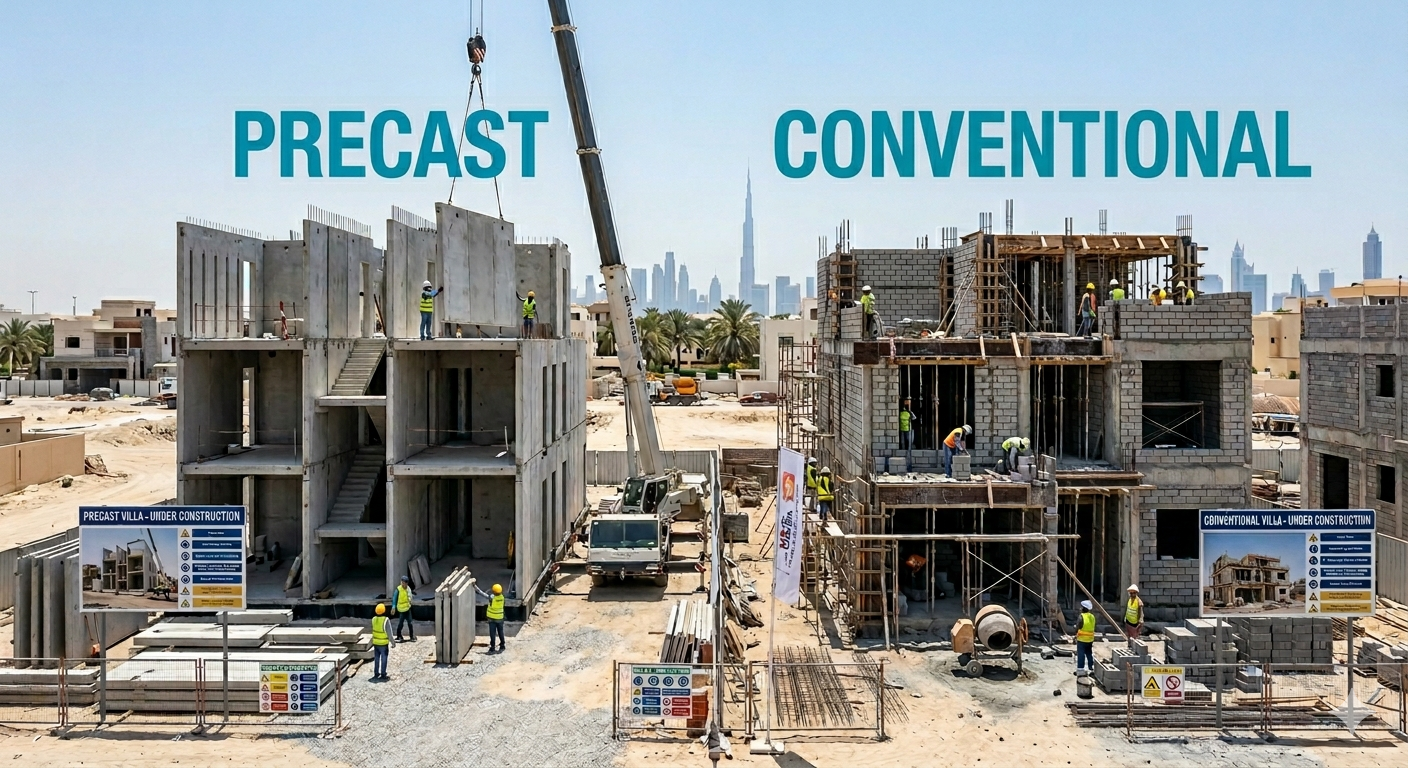
The United Arab Emirates stands at a pivotal moment in its construction history. With a residential pipeline exceeding AED 106 billion in Abu Dhabi alone, and Dubai’s villa and townhouse communities continuing to attract global investment, the pressure on developers to deliver faster, smarter, and more cost-efficiently has never been greater. At the centre of this debate is one of the industry’s most consequential procurement decisions: should a villa development be built using conventional cast-in-situ concrete — the time-honoured method of pouring concrete on-site — or using a precast construction system, where structural components are factory-manufactured and assembled on site?
The answer, as this analysis demonstrates, is not straightforward. It depends critically on scale. At low volumes, conventional construction is clearly more economical. But a precise crossover point exists — a breakeven volume — beyond which precast delivers compelling cost, speed, and quality advantages. Understanding that crossover, and knowing which villa product type maximises the benefit, is now a core competency for any serious UAE developer.
“The UAE’s prefabricated construction industry is forecast to reach AED 32.28 billion by 2029, driven by modular methods, digital design integration, and the push for faster delivery.”
The UAE Construction Landscape in 2025–26
Construction costs across the UAE have risen steadily in recent years. According to Turner & Townsend’s 2025 UAE Market Intelligence Report, Dubai was ranked 74th globally at a cost of US$1,926 per square metre — making it the most affordable major construction market in the Middle East, yet still one experiencing notable inflationary pressure. Materials now account for approximately 60 percent of baseline construction costs in the UAE, with steel, concrete, and MEP components all subject to upward price movement.
For villa construction specifically, costs range from AED 300 to AED 500 per square foot for standard finishes, rising to AED 900 to AED 1,400 per square foot for luxury villas, according to Engel & Völkers UAE Construction Cost Guide 2026. Upper-market villa developments are benchmarked at AED 9,100 to AED 11,250 per square metre per the Compass Project Consulting H2 2024 Benchmark Report. Tender price inflation for 2025 is forecast at 3.3 percent.
The UAE’s precast market is dominated by players such as Gulf Precast Concrete Co. — the largest precast manufacturer in the country, operating five factories with a daily capacity of 1,500 m³ — Dubai Precast (an NSL/YTL Group subsidiary), and Bait Al-Jazeera. This market is forecast to grow at approximately 4.4 percent annually, with thousands of villas now delivered using precast systems across the UAE.
Understanding the Cost Difference
The Baseline Premium
At the level of a single villa, precast construction carries a premium of approximately 25 percent over conventional cast-in-situ methods on a like-for-like structural cost basis. This premium arises from three primary sources: the upfront cost of engineering bespoke molds, factory overhead and transportation logistics, and specialist crane and erection costs. According to Glasgow Research & Consulting’s UAE Precast Market Report, this premium is well-established and consistent across all villa product types.
For a medium-sized villa of 8,000 square feet built at a conventional mid-range rate of AED 520 per square foot, the structural cost per unit would be approximately AED 4.16 million. A single precast unit of the same specification would cost approximately AED 5.2 million — an additional AED 1.04 million. This premium is not a fixed surcharge; it reduces systematically as volume increases.
How Volume Erodes the Premium
The precast premium declines as volumes grow because the fixed costs of mold design, factory setup, and engineering are distributed across more units. The pattern follows a consistent curve:
| Volume Range | Precast Premium | Notes |
|---|---|---|
| 1 – 50 units | 17% – 25% | Conventional clearly cheaper |
| 51 – 100 units | ~11% | Gap narrowing; plan for precast |
| 101 – 200 units | ~7% | Approaching parity |
| 201 – 500 units | 0% – 3% | Near parity; engage precast contractor |
| 500 – 1,000 units | 0% (Breakeven) | Structural cost breakeven |
| 1,000+ units | −3% to −7% | ✅ Precast clearly cheaper |
The Breakeven Matrix: By Product Type
All five villa product types reach approximately the same structural cost breakeven — between 500 and 560 units. This is consistent with research by Glasgow Research & Consulting, which established the 500–1,000 unit range as the convergence point for precast and conventional costs in the UAE.
| Property Type | @ 1 Unit | @ 100 Units | @ 300 Units | @ 500 Units | @ 1,000 Units |
|---|---|---|---|---|---|
| Townhouse (2,500 sq ft) | +25% | +11% | +3% | 0% Breakeven | −7% Cheaper ✅ |
| Small Villa (5,000 sq ft) | +25% | +11% | +3% | 0% Breakeven | −7% Cheaper ✅ |
| Medium Villa (8,000 sq ft) | +25% | +11% | +3% | 0% Breakeven | −7% Cheaper ✅ |
| Large Villa (10,000 sq ft) | +25% | +11% | +3% | ~0% Breakeven | −7% Cheaper ✅ |
| Mega Villa (12,000 sq ft) | +25% | +11% | +3% | ~0% Breakeven | −7% Cheaper ✅ |
The Hidden Advantage: Indirect Savings
Construction speed is one of precast’s most compelling advantages. Precast assembly is typically two to three times faster than conventional in-situ methods, as documented by Elematic’s UAE precast villa case studies. A real-world demonstration saw 171 villas and 304 townhouses completed in just 18 months in Dubai — approximately one villa and two townhouses per day.
This speed-to-market advantage generates substantial indirect savings per unit:
- Townhouse (2,500 sq ft): 8-month time saving @ AED 8,000/month = AED 64,000 per unit
- Small Villa (5,000 sq ft): 8-month time saving @ AED 15,000/month = AED 120,000 per unit
- Medium Villa (8,000 sq ft): 10-month time saving @ AED 24,000/month = AED 240,000 per unit
- Large Villa (10,000 sq ft): 12-month time saving @ AED 38,000/month = AED 456,000 per unit
- Mega Villa (12,000 sq ft): 14-month time saving @ AED 55,000/month = AED 770,000 per unit
Precast also reduces on-site preliminary costs by approximately 35 percent, requires approximately 50 percent less on-site manpower, and allows contingency budgets to be reduced from 10 percent to approximately 7 percent due to factory-controlled quality assurance.
“When indirect savings are included, the effective breakeven for precast villa construction in the UAE falls to just 300–360 units — within reach of most mid-scale master developers.”
Breakeven Summary and Savings at Scale
| Property Type | Structure Only Breakeven | Incl. Indirect Savings | Saving/Unit @ 1,000 | Best Use Case |
|---|---|---|---|---|
| Townhouse | ~500 units | ~300 units | AED 73,500 | Govt. & affordable housing |
| Small Villa | ~520 units | ~320 units | AED 168,000 | Mid-income communities |
| Medium Villa ⭐ | ~530 units | ~340 units | AED 286,560 | Master-community developers |
| Large Villa | ~550 units | ~350 units | AED 390,600 | Premium developments |
| Mega Villa | ~560 units | ~360 units | AED 546,000 | Luxury estates (500+ units) |
Sources: Glasgow Research & Consulting; Elematic precast villa analysis; UAE construction cost benchmarks 2024–2026.
Which Product Type Is Most Economical?
Townhouses: The Optimal Choice for Volume Developers
For government housing programmes and affordable residential communities — the backbone of the UAE’s national housing agenda — the townhouse format (2,000 to 3,500 square feet, G+1 or G+2) represents the single best application of precast technology. The Sheikh Zayed Housing Programme and the Abu Dhabi Housing Authority’s AED 106 billion Emirati housing initiative both rely extensively on precast for precisely this reason. At a breakeven of approximately 300 units (including indirect savings), townhouses allow developers with relatively modest pipelines to capture precast’s benefits, with a total project saving exceeding AED 73 million at 1,000 units.
Medium Villas: The Best Developer ROI
For private master-community developers such as Emaar, Aldar, Meydan, and DAMAC, the medium villa format (7,000 to 9,000 square feet) delivers the optimal balance of precast economics. Units are large enough to generate substantial absolute savings per unit, yet standardised enough across a community to allow mold reuse rates that drive costs down efficiently. Dubai Precast’s residential portfolio — which includes Jumeirah Golf Estates and Yas Island Emirati villas — demonstrates that this format is commercially validated. A developer building 1,000 medium villas using precast could save in excess of AED 286 million compared to conventional construction.
Large and Mega Villas: Viable but Nuanced
Large villas (10,000 sq ft) and mega villas (12,000 sq ft and above) can deliver exceptional absolute savings — up to AED 546,000 per unit for a mega villa at 1,000 units. However, greater design complexity and bespoke architectural requirements limit mold reuse. These formats require early-stage collaboration between developer, architect, and precast contractor to optimise design for factory production. Precast is viable for these formats above approximately 350 to 360 units, but the risk profile and design discipline required are more demanding.
Long-Term Operating Advantages of Precast
The economic case for precast extends well beyond the construction phase. Precast villas built with insulated sandwich wall panels perform significantly better thermally than conventional counterparts. In the UAE, where cooling accounts for approximately 50 percent of all building energy consumption, this matters enormously. Precast walls with integrated insulation can reduce annual cooling costs by an estimated 25 to 30 percent — a direct and ongoing benefit to homeowners and rental yield for investors.
Long-term maintenance costs for precast villas are typically 15 to 20 percent lower over a 20-year lifecycle. Factory-controlled production minimises the micro-cracking and surface defects common in site-poured concrete exposed to the UAE’s extreme heat during curing, reducing the need for remedial waterproofing, repainting, and structural repairs. For developers managing rental communities or offering long-term structural warranties, this lifecycle saving directly improves net operating income.
Who Is Already Doing This in the UAE?
The precast villa market in the UAE is no longer experimental — it is mainstream. Key active participants include:
- Meydan Group (Dubai): Recently awarded Dubai Precast a contract for 93 townhouses and two villas using full precast structural systems, with installation targeted for Q4 2026.
- Aldar Properties (Abu Dhabi): Responsible for the fully precast Emirati villa community on Yas Island, as well as housing projects under the Abu Dhabi Housing Authority’s AED 106 billion programme.
- UAE Government / Abu Dhabi Housing Authority: The single largest driver of precast villa construction in the country, with tens of thousands of Emirati homes delivered or planned using precast systems. The Sheikh Zayed Housing Programme has been a consistent champion of precast for government housing.
- Gulf Precast Concrete Co.: The UAE’s largest precast manufacturer with 40+ years of experience, 5 factories, and 3,500+ professionals serving projects across all seven emirates.
Conclusion: A Decision Driven by Scale
The debate between precast and conventional construction for UAE villas resolves to a single governing principle: scale. Below 100 units, conventional construction is unambiguously the more economical choice — typically 17 to 25 percent cheaper on a structural cost basis. Between 100 and 300 units, the gap narrows and developers should begin to plan for precast. Between 300 and 500 units, precast reaches cost parity and begins to offer net benefits. Above 500 units, precast is the clearly superior economic and operational choice.
For developers seeking the optimal product type, the evidence points clearly to townhouses and medium villas as the formats where precast delivers the most compelling combination of breakeven accessibility, saving magnitude, and design repeatability. Townhouses at large scale are the standout application for government housing. Medium villas at 7,000 to 9,000 square feet offer the best overall return on investment for private master-community developers.
The UAE’s construction market is evolving rapidly. Developers who understand the economics of scale, engage precast contractors early in design, and structure their pipelines to reach or exceed the 300 to 500 unit threshold will be best positioned to capture meaningful competitive advantage — not just in the construction phase, but across the entire asset lifecycle.
References & External Sources
- Turner & Townsend — UAE Market Intelligence 2025: Construction Cost Performance
- Compass Project Consulting — KSA & UAE Construction Cost Benchmark Report H2 2024
- Engel & Völkers UAE — Construction Cost in Dubai: Per Sq Ft Rates & Budgeting (2026)
- Glasgow Research & Consulting — Market for Precast Concrete in UAE
- Elematic — How to Build 1,000 Villas in a Year Using Precast Concrete Technology
- Elematic — Luxury Apartments Built with Precast Concrete in Dubai
- Dubai Precast — Residential Projects Portfolio
- Gulf Precast Concrete Co. — UAE’s Largest Precast Manufacturer
- PropertyNews.ae — Dubai Precast Secures Major Residential Contract at Meydan
- UAE Ministry of Energy & Infrastructure — Sheikh Zayed Housing Programme
- Abu Dhabi Media Office — UAE President Witnesses Launch of 13 New Residential Projects (AED 106 Billion)
- The Arabian Post — Meydan Award Boosts Dubai Precast Push
- Habhab Construction — Villa Construction Cost in Dubai 2025
- GJ Properties — How Much Does It Cost to Build a House in UAE?
© GreenArch World | Construction Intelligence Report | April 2026. All figures based on publicly available market data and industry benchmarks. For project-specific cost advice, consult a qualified quantity surveyor.