Shopping malls have evolved far beyond simple retail destinations. Today they are community hubs, lifestyle centres, and economic engines. Whether you are an architect, developer, or investor, understanding the principles that govern great mall design — and what it costs to build one — is essential to delivering a successful project. This article covers the key design principles, global standards to reference, a real-world UAE case study, a detailed construction cost estimate for a 50,000 sq ft mall, and a revenue model to help you evaluate the financial viability of your project.
Part 1: Important Principles of Mall Design
1. Anchor Tenant Strategy
The anchor tenant model remains a cornerstone of mall planning. A few dominant stores — or increasingly, entertainment venues, cinemas, food halls, and hypermarkets — act as primary footfall drivers that pull visitors through the mall, past smaller tenants. As traditional department stores face headwinds globally, forward-thinking developers are rethinking anchors: replacing them with experiential draws such as indoor adventure parks, rooftop cineplexes, and large-format F&B destinations.
2. Circulation and Wayfinding
Clear, legible pedestrian flow is critical in any mall. Best practice calls for no secondary corridors or hidden corners, ensuring visual connectivity to all shopfronts. Large malls use quadrant circulation patterns with recognisable nodes — rest areas, atriums, or landmark features — to aid orientation and encourage dwell time. In a large-scale environment, getting lost is a guaranteed way to lose repeat visitors.
3. Experience-First Design
The most significant shift in contemporary mall design is the move from transactional to experiential thinking. Planners must take a holistic view of the entire shopper journey — from arrival and parking, through navigation and discovery, to dining and departure. Malls that offer something beyond simple retail — community events, art installations, interactive environments — create the social gravity that brings visitors back again and again.
4. Floor Plan Balance: Retail, Dining and Entertainment
A well-designed floor plan balances retail with dining and entertainment in a way that drives footfall without creating congestion. Food & beverage zones should be positioned to draw people to the ends of malls or upper floors — areas that would otherwise receive lower foot traffic. Entertainment anchors (cinemas, play zones, fitness centres) are placed to maximise dwell time and cross-shopping.
5. Safety, Accessibility and Evacuation
Safety and accessibility are non-negotiable. Emergency exits, evacuation routes, and fire suppression systems must be integrated from day one of design. Accessible features — ramps, lifts, wide corridors, accessible parking and toilet facilities — are both a legal requirement and a mark of quality design. Digital wayfinding and in-mall navigation tools are increasingly used to communicate evacuation procedures to visitors.
6. Pedestrian and Vehicle Coordination
Separating pedestrian and vehicle movement is fundamental to mall site design. A clearly marked, continuous walkway network must link all entrances to public sidewalks, transit stops, and street crossings. Drop-off zones, rideshare points, and delivery access routes must be segregated from customer footpaths to ensure both safety and a pleasant arrival experience.
7. Sustainability and Energy Efficiency
Malls are among the most energy-intensive building types, with high demands for lighting, air conditioning, and ventilation. Green roofs, solar PV installations, LED lighting with DALI controls, rainwater harvesting, and high-performance building envelopes are increasingly standard. In the UAE context, LEED and Estidama certifications provide a framework for reducing both operational costs and carbon footprint over the building’s life.
8. Landscaping and Biophilic Design
Internal and external greenery significantly enhances the visitor experience. Plants improve air quality, control humidity, and create a calming atmosphere. Feature trees, living walls, water features, and landscaped plazas all contribute to a sense of place — transforming a mall from a commercial box into a destination that feels alive.
9. Technology Integration
Smart mall technology — from AI-powered indoor navigation and digital directories to augmented reality retail experiences and real-time footfall analytics — is now part of contemporary mall design. Building Management Systems (BMS) integrate HVAC, lighting, security, and energy monitoring into a single platform. These technologies improve the visitor experience while giving operators the data they need to optimise tenant mix and operational performance.
10. Site Selection and Market Analysis
Before a line is drawn, thorough market analysis is essential. Understanding the competitive landscape, the demographics of the catchment area, transport connectivity, zoning regulations, and the specific retail and leisure gaps in the market will determine whether a mall project succeeds or struggles. A strong site in an underserved location with clear transport links is worth far more than a beautifully designed mall in the wrong place.
Part 2: Key Standards and References for Mall Design
The following standards and reference documents are widely used in mall design and should be consulted during the design and development process:
| Standard / Reference | Scope |
|---|---|
| ICSC Design Principles & Practices | Retail planning, tenant mix, circulation best practices |
| ULI — Ten Principles for Rethinking the Mall | Mixed-use integration, experience-led and community-focused design |
| ADA / UAE Accessibility Guidelines | Accessible ramps, parking, lifts, restrooms and wayfinding |
| LEED / Estidama (UAE) | Sustainable building design, energy, water and material performance |
| NFPA / UAE Civil Defence Standards | Fire suppression, evacuation routes, emergency egress design |
| Metric Handbook (David Adler) | Column spacing (6–9m), store depths (11–13m), parking ratios |
| IS 456:2000 / Local Structural Codes | Reinforced concrete design for structural members |
| Dubai Building Code / UAE National Building Code | Local regulatory compliance for permits, heights, setbacks, MEP |
Key technical benchmarks include: column spacing of 6–9 metres, retail unit depths of 11–13 metres, parking ratios of 5–6 spaces per 100 sq m of GLA, and minimum mall concourse widths of 6–8 metres.
Part 3: Case Study — Dubai Hills Mall, Dubai
Dubai Hills Mall is one of the UAE’s most compelling examples of contemporary community-focused mall design. Situated between Downtown Dubai and Dubai Marina within the 2,700-acre Dubai Hills Estate master plan, it offers a range of design lessons for architects and developers.
Key Design Points
- Streets and Squares Concept: The mall adopts a ‘streets and squares’ approach inspired by traditional European shopping districts, bringing exterior streetscape character into the interior through shopfront detailing, canopies, and varied lighting.
- Scale and Mix: With a GLA of 2,000,000 sq ft across two floors, it accommodates over 600 retail and F&B outlets, Roxy Cinemas, an 18-screen rooftop cineplex, and an Adventure Park with an indoor rollercoaster.
- Community Plazas: Three distinct plazas provide dedicated space for dining, leisure, and community events. A large skylight canopy over the Urban Market dining zone floods the interior with natural light.
- Sustainability: A rooftop solar PV installation generates approximately 6.5MW of power annually, delivering projected energy savings of AED 120 million over 25 years. The multi-storey car park accommodates more than 7,000 vehicles.
- Anchor Mix: Seven anchor retail stores, a 6,000 sq m hypermarket, four family entertainment centres, clinics and spas provide a comprehensive neighbourhood offering.
- Biophilic Design: Artificial trees averaging 7 metres in height are integrated throughout the mall, creating a serene, nature-inspired atmosphere that enhances the visitor experience.
- Design Team: CallisonRTKL developed the master plan; JLL served as project manager across a large international multi-discipline design team.
Dubai Hills Mall demonstrates that a mall built around a clear design philosophy — neighbourhood retail street, community gathering, sustainability — can become a genuine destination rather than just a shopping centre.
Part 4: Construction Cost Plan — 50,000 Sq Ft Mall in the UAE
The following is an Order-of-Magnitude cost estimate for a mid-range community shopping mall of 50,000 sq ft (approximately 4,645 sqm) built-up area in the UAE. Figures are based on Knight Frank UAE Construction Landscape H1 2025, Turner & Townsend UAEMI 2025, and West Gate Real Estate market data for 2025.
Project Assumptions
- Mid-range community mall specification
- Two floors (Ground + First)
- 400 parking spaces (multi-storey)
- Does not include land cost
- Base date: 2025–26 | Currency: AED
- Contingency: 12%
Elemental Cost Summary
| Element | Low (AED) | Mid (AED) | High (AED) |
|---|---|---|---|
| 1. Substructure & Structure | 3,540,000 | 4,395,000 | 5,565,000 |
| 2. Building Envelope & External Works | 2,100,000 | 2,890,000 | 4,020,000 |
| 3. Internal Finishes — Common Areas | 3,750,000 | 5,080,000 | 7,150,000 |
| 4. MEP Services | 6,940,000 | 9,230,000 | 12,530,000 |
| 5. Parking Structure (400 spaces) | 12,580,000 | 16,520,000 | 22,380,000 |
| 6. Contractor Preliminaries & Overheads | 1,134,000 | 1,599,500 | 2,336,500 |
| 7. Professional Fees & Authority Costs | 1,470,000 | 2,170,000 | 3,240,000 |
| Base Construction Cost | 31,514,000 | 41,884,500 | 57,221,500 |
| Contingency @ 12% | 3,781,680 | 5,026,140 | 6,866,580 |
| TOTAL PROJECT COST ESTIMATE (AED) | 35,295,680 | 46,910,640 | 64,088,080 |
| TOTAL PROJECT COST ESTIMATE (USD) | ~USD 9.6M | ~USD 12.8M | ~USD 17.5M |
| Overall Rate (AED / sq ft BUA) | ~AED 706 | ~AED 938 | ~AED 1,282 |
Note: This is a pre-design order-of-magnitude estimate only. A detailed Bills of Quantities prepared by a registered UAE Quantity Surveyor is recommended prior to tender. Rates sourced from Knight Frank UAE Construction Landscape H1 2025 and Turner & Townsend UAEMI 2025.
Major Cost Drivers to Watch
- Location premium: Sites in Dubai Hills Estate, Downtown Dubai, or Abu Dhabi add 20–30% to base cost.
- F&B zones: Full-service restaurant fit-out costs AED 800–1,500+ per sq ft due to heavy MEP loads (grease traps, extraction, gas lines).
- Entertainment anchors: Cinemas, indoor adventure parks, and play zones carry specialist structural and MEP premiums.
- Tender Price Inflation: UAE TPI is forecast at 3.3% for 2025 (Turner & Townsend UAEMI 2025).
- Preliminaries: Dubai recorded preliminary costs of up to 14% for larger projects in 2025.
Part 5: Revenue Model — 50,000 Sq Ft Mall in the UAE
Area Assumptions
In a typical shopping mall, not all of the built-up area is leasable to tenants. Common areas — mall concourses, atriums, toilets, plant rooms, loading bays, management offices, and circulation — typically account for 30–40% of BUA. The remaining 60–70% forms the Gross Leasable Area (GLA) available for revenue generation.
| Area Component | % of BUA | Area (sq ft) |
|---|---|---|
| Total Built-Up Area (BUA) | 100% | 50,000 |
| Common Areas, Circulation & Back-of-House | 35% | 17,500 |
| Gross Leasable Area (GLA) | 65% | 32,500 |
GLA Tenant Mix Breakdown
| Zone / Use | % of GLA | Area (sq ft) | Typical Rent (AED/sq ft/yr) | Annual Revenue (AED) |
|---|---|---|---|---|
| Anchor Retail (2–3 units) | 25% | 8,125 | 100 – 150 | ~1,015,625 |
| Inline Retail (apparel, accessories, services) | 35% | 11,375 | 180 – 280 | ~2,616,250 |
| Food & Beverage (restaurants, cafés, QSR) | 20% | 6,500 | 200 – 320 | ~1,690,000 |
| Entertainment / Leisure | 10% | 3,250 | 120 – 180 | ~487,500 |
| Kiosks, Pop-ups & Specialty | 5% | 1,625 | 350 – 600 | ~771,875 |
| Services (clinic, salon, banking) | 5% | 1,625 | 160 – 220 | ~292,500 |
| Total GLA | 100% | 32,500 | — | — |
Revenue Summary (Mid-Case Estimate)
| Revenue Stream | Annual (AED) | Annual (USD approx.) |
|---|---|---|
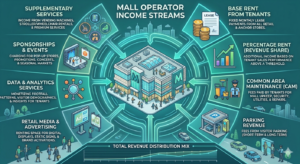
| Base Rent — All Tenants (mid rates) | 6,873,750 | ~1,873,000 |
| Service Charge Recovery (est. 15% of rent) | 1,031,063 | ~281,000 |
| Turnover Rent Top-Up (est. 5% of base) | 343,688 | ~94,000 |
| Parking Revenue (400 spaces @ AED 5/hr, 8hr, 300 days) | 4,800,000 | ~1,308,000 |
| Advertising / Media Panels & Sponsorship | 500,000 | ~136,000 |
| Total Gross Revenue (Mid-Case) | ~13,548,500 | ~USD 3,692,000 |
Operating Cost Deductions (Estimate)
| Operating Cost | Annual (AED) |
|---|---|
| Facilities Management & Cleaning | 1,200,000 |
| Utilities (DEWA — net of service charge recovery) | 900,000 |
| Security | 600,000 |
| Marketing & Events | 400,000 |
| Insurance & Rates | 250,000 |
| Management Fee (5% of gross revenue) | 677,425 |
| Total Operating Costs | ~4,027,425 |
Net Operating Income (NOI)
| Metric | AED | USD (approx.) |
|---|---|---|
| Gross Revenue | 13,548,500 | ~3,692,000 |
| Less: Operating Costs | (4,027,425) | ~(1,097,000) |
| Net Operating Income (NOI) | 9,521,075 | ~2,595,000 |
| NOI Yield on Total Project Cost (Mid) | ~20.3% per annum | |
| Simple Payback Period | ~4.9 years | |
Key Revenue Assumptions and Notes
- Rental rates are based on Dubai community mall market data 2025. Premium locations (Downtown, Dubai Hills) command 20–40% premiums.
- Occupancy rate assumed at 90% for revenue calculations. A newly opened mall may achieve 75–80% occupancy in Year 1, building to 90%+ by Year 3.
- Turnover rent clauses (typically 8–12% of tenant turnover above a threshold) can add significant upside in a well-performing mall.
- Anchor tenants typically negotiate lower base rents (AED 80–120/sq ft) but drive footfall that supports higher inline rents.
- F&B and kiosk units generate the highest rent per square foot and should be prioritised in tenant mix strategy.
- Service charge income is ring-fenced for common area maintenance costs; shown here gross for completeness.
- A detailed Discounted Cash Flow (DCF) model incorporating lease-up profile, rent reviews, capex cycles, and financing should be prepared for investment-grade analysis.
Conclusion
Building a successful shopping mall in the UAE requires far more than good architecture. It demands a clear understanding of the community it will serve, a disciplined approach to design principles, rigorous cost planning, and a credible revenue strategy. For a 50,000 sq ft community mall in the UAE, developers should budget approximately AED 47–65 million (USD 12.8–17.5M) all-in for construction, and can expect an annual Net Operating Income of around AED 9.5 million (USD 2.6M) at stabilised occupancy — representing a compelling yield for a well-located, well-designed asset.
The most successful malls — from Dubai Hills to The Grove in Los Angeles — share one quality: they are places people want to be, not just places people go to shop. Design with that principle at the centre, and the numbers will follow.
Disclaimer: All cost and revenue figures are indicative estimates based on publicly available UAE market data (Knight Frank H1 2025, Turner & Townsend UAEMI 2025, West Gate Real Estate 2025). They should not be relied upon as a substitute for a detailed feasibility study or Bills of Quantities prepared by a registered UAE Quantity Surveyor and financial advisor.