
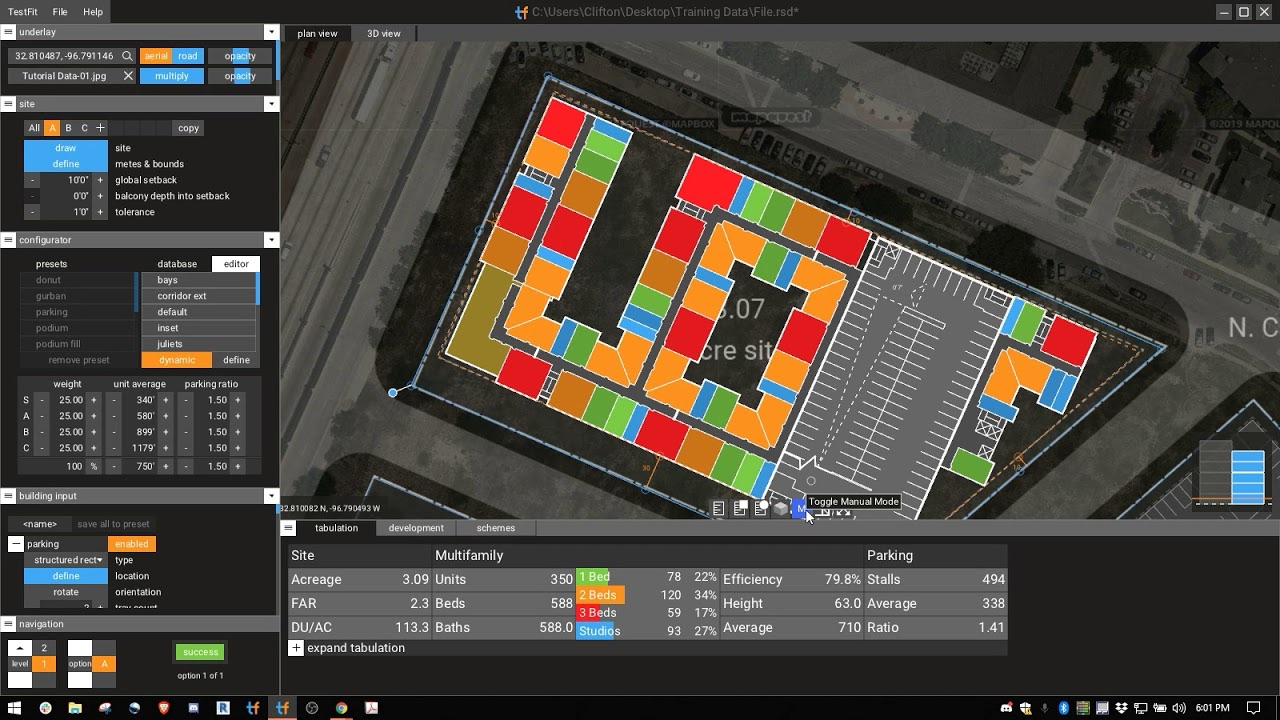
A review of the tool “TestFit” for real estate feasibility exercises.
Overview
TestFit has quickly become a go-to tool in early-stage real estate development. Sitting at the crossroads of computational design, financial analysis, and parametric planning, it aims to shrink feasibility timelines from weeks down to hours by automating site planning and yield analysis.
For developers, architects, and investors — especially those handling large volumes of land deals — TestFit represents a genuine shift in how feasibility studies get done, moving away from manual processes toward real-time, data-informed decisions.
That said, while its strengths are well-established — particularly in North America — it’s worth taking a hard look at where it struggles, especially when applied to residential projects outside the US, where planning systems, building types, and regulations work very differently.
Where TestFit Shines
At its heart, TestFit is a constraint-driven design engine. It takes user-defined inputs and generates workable site layouts based on them.
Users feed in things like site boundaries, zoning rules, setbacks, parking requirements, and preferred unit mixes. In return, the tool produces building layouts and massing models, unit counts, parking configurations, and rough cost and yield estimates.
The real value is in how fast it works. TestFit can run through thousands of layout options in seconds and update them on the fly, letting developers explore a wide range of scenarios without the usual back-and-forth.
In terms of where it fits in the process, it lives squarely in the pre-design phase — effectively replacing manual massing models done in SketchUp, Excel-based feasibility sheets, and the time-consuming coordination between architects and developers.
This makes it especially useful for screening land acquisitions, making quick go/no-go calls, and building investor presentations with real numbers behind them. Developers report getting feasibility outputs within roughly 10–15% accuracy in under an hour — work that used to take weeks.
Main Use Cases
1. Screening Multiple Sites at Once TestFit is at its best when a developer is evaluating several sites in parallel. It helps teams quickly rule out weak options and zero in on the most promising ones.
2. Multifamily Feasibility in a US Context The platform is built around common North American housing types — garden apartments, podium buildings, townhouses, and mixed-use blocks — making it highly efficient for these typologies.
3. Early Financial Checks Unlike standard design tools, TestFit weaves financial logic directly into the design process, letting users look at yield, density, and cost all at once.
4. Communicating with Stakeholders The ability to generate and compare multiple schemes in real time is a strong asset when presenting to investors, planners, or internal teams.
Key Strengths
The most talked-about benefit is speed — feasibility tasks that once took days can be wrapped up in minutes. Beyond that, linking geometry to financial performance means decisions are grounded in evidence rather than instinct. Outputs can also be exported into tools like Revit and AutoCAD, keeping things connected through later design stages. And for institutional developers in particular, it introduces a consistent, scalable approach to feasibility.
Where It Falls Short
Despite its strengths, TestFit has some real structural limitations — ones that become harder to ignore outside its home market.
1. Built Around US Planning Logic TestFit is fundamentally designed with US-style zoning in mind — numerical rules around setbacks, parking ratios, and floor area ratios. Many international markets don’t work this way. In the UK, UAE, and across Europe, planning is often more discretionary, guided by design quality and case-by-case review rather than fixed numbers. This makes it difficult to map local rules into TestFit’s parameters, and the platform has no built-in datasets for most international markets.
2. Over-Optimized for Parking The tool’s layout logic is heavily shaped around parking — a reflection of US suburban development patterns. In cities like Dubai, London, or Singapore, where parking requirements are lower and shared mobility is more common, this can lead to overestimated parking areas, wasted land, and misleading outputs if the assumptions aren’t carefully adjusted.
3. Struggles with High-Density Typologies TestFit works best with low-to-mid-rise buildings and repetitive floor plans. But in many international markets, residential development means high-rise towers, complex podium-and-tower combinations, or mixed-use vertical schemes. The tool has difficulty modeling vertical circulation efficiently, and its unit layouts don’t easily accommodate things like maid’s rooms, larger kitchens, or luxury finishes that are standard in many markets.
4. Weak on Difficult or Irregular Sites The platform doesn’t handle small plots, irregular shapes, or tight urban infill well — precisely the conditions where feasibility analysis is most needed in mature cities and high-value urban land markets.
5. No Sense of Context or Design Quality TestFit optimizes for numbers: yield, density, financial return. It doesn’t factor in architectural character, cultural expectations, or how a building relates to its surroundings. In markets like the UAE, where branding, façade quality, and lifestyle positioning carry enormous weight, this is a significant gap.
6. Data Gaps Outside the US The platform’s built-in datasets are largely US-focused. In other markets, users have to manually input zoning rules, parking standards, and infrastructure constraints — which chips away at the speed advantage and raises questions about output reliability.
7. Limited Manual Control While the generative outputs are strong, manually refining them is clunky and unintuitive. This creates a disconnect between what TestFit produces and what an architect actually needs to move forward with a concept.
8. Generic Financial Assumptions The cost and yield estimates it produces are often based on broad assumptions. Regional factors — local construction costs, sales values, financing structures, investor expectations — need to be layered in manually. In a market like Dubai, where margins, sales pace, and investor dynamics vary considerably, this requires a much more sophisticated financial model alongside it.
What This Means for Developers Outside the US
For teams working in the UAE, UK, or Asia, TestFit is a useful starting point — but it shouldn’t be treated as the final word. It’s well-suited to early-stage land screening, rough density testing, and comparing multiple scenarios side by side. It’s not suitable as a standalone feasibility tool for high-rise projects, design-led developments, or anything requiring regulatory precision. In these contexts, it offers speed — not certainty.
How to Position It
Think of TestFit as a feasibility accelerator, not a planning or design authority. Its best role is at the front end of the development pipeline, feeding into more detailed BIM workflows, refined financial models, and proper design development.
Final Thoughts
TestFit is a meaningful step forward in how real estate feasibility gets done. The ability to run through options quickly, tie design choices to financial outcomes, and present credible numbers early in the process makes it genuinely valuable — particularly in rule-based markets like the United States.
But its usefulness drops off in international settings, especially for high-density residential projects with complex regulations or design-driven approvals.
For developers outside the US — including those working in Dubai — the right approach is to use TestFit selectively: as a rapid-testing tool in the early stages, not as a replacement for proper feasibility work.
The bigger opportunity lies in combining tools like TestFit with local regulatory knowledge, sophisticated BIM processes, and context-aware design thinking. Until that integration matures, experienced human judgment remains the essential bridge between algorithmic outputs and real-world development decisions.
Related Reading
For a deeper dive into feasibility methodology and investment analysis in the UAE and real estate context:
- Real Estate Feasibility – Massing Studies — A step-by-step guide to the manual massing and test fit process that tools like TestFit aim to automate.
- UAE Construction Equipment Rental: Market Evaluation & Investment Feasibility — A full-scale investment feasibility for a UAE construction business, with 5-year projections and risk analysis.
- Is a Swimming Pool Business in Dubai Actually Profitable? — A financial feasibility model for another Dubai construction sector SME opportunity.
- Our Feasibility Studies & Due Diligence Services — Expert-led technical feasibility, massing studies, and area statements for developers and investors.