UAE Urban Planning · Master Development · 2026
How Nakheel and Emaar Masterplan Dubai — and What’s Still Missing
A deep-dive audit of the Gulf’s two dominant master developers — their shared design DNA, ten systemic gaps, and a twelve-principle framework for the next generation of UAE masterplans.
Coverage · Nakheel & Emaar
Scope · Waterfront · Mixed-Use · Residential
Date · April 2026
Contents
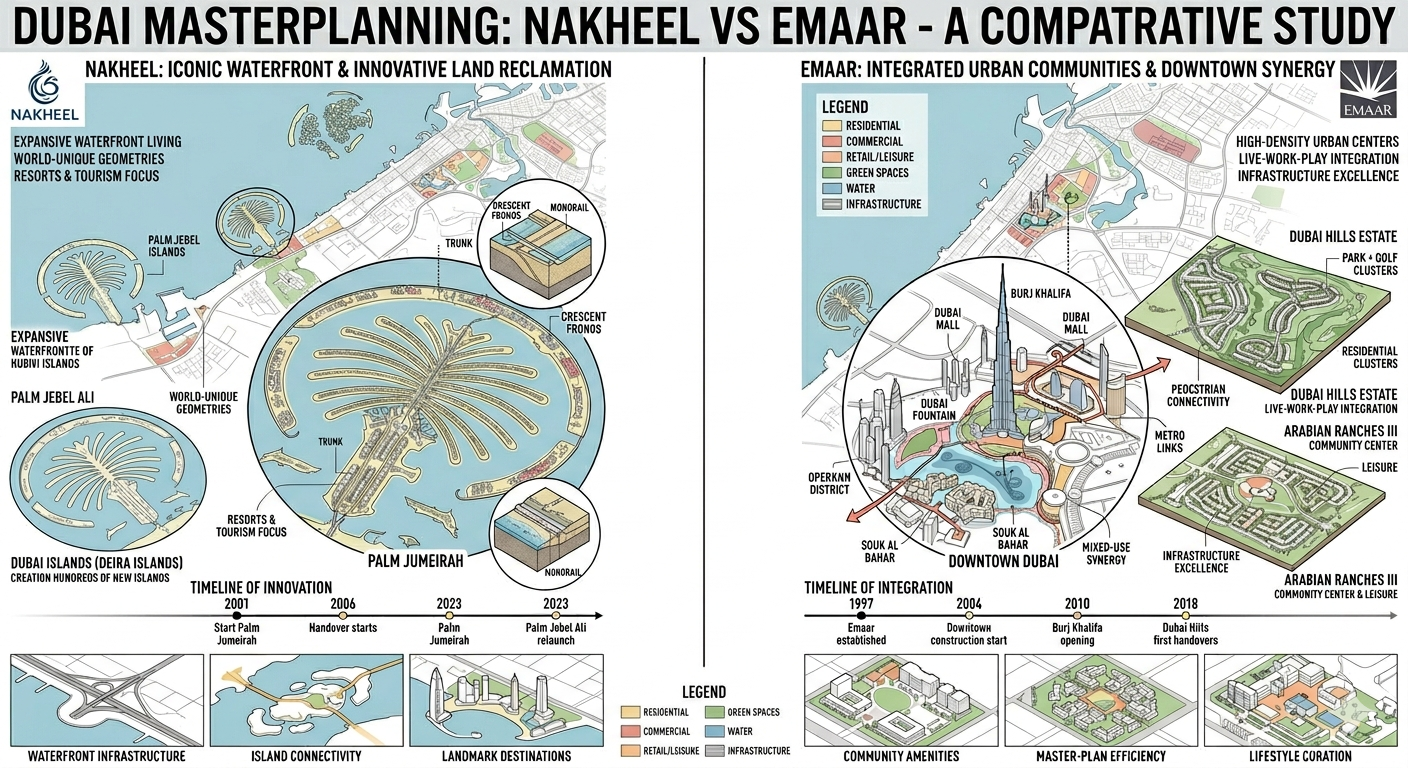
Nakheel and Emaar have together written the modern playbook for Gulf city-making, but that playbook now looks partial against a 2040 horizon that demands bioclimatic design, transit-oriented density, and measurable carbon performance. Nakheel’s signature is the iconic, land-reclaimed waterfront — Palm Jumeirah, Palm Jebel Ali, The World, Dubai Islands — engineered to multiply coastline and manufacture destination value. Emaar’s signature is the integrated “city-within-a-city,” anchored by a hero landmark and stitched together by mall, golf course, promenade, and branded hospitality.
Each has delivered tens of thousands of units and billions in capital appreciation. But the Dubai 2040 Urban Master Plan, the UAE Net Zero 2050 Strategy, and the post-April-2024 flood reality are collectively re-pricing what “good masterplanning” means. This article audits both developers against their own practice and against global benchmarks — from Masdar City to Msheireb Downtown Doha — and proposes a consolidated best-practice framework.
Nakheel — Engineering the Coastline as Product
Nakheel, now a member of Dubai Holding Real Estate, treats geography itself as a design tool. Launched in 2001, the company has extended Dubai’s original 70 km shoreline by more than 300 km through dredge-and-reclaim engineering at unprecedented scale. Its flagship, Palm Jumeirah, stretches 5 km into the Arabian Gulf across 560 hectares, houses roughly 25,000 residents on a trunk-frond-crescent geometry, and anchors itself with Atlantis The Palm, Nakheel Mall, and the Middle East’s first monorail.
Palm Jebel Ali, revived in May 2023 after a 15-year pause, is roughly twice Palm Jumeirah’s footprint at 13.4 km², comprising 16–17 fronds adding 110 km of coastline. It targets 35,000 families and will host more than 80 hotels, with first villas handing over in late 2027. Around one-third of public facilities are planned to run on renewable energy — a notable shift from the pure-spectacle positioning of the original era.
Dubai Islands (formerly Deira Islands), unveiled August 2022, comprises five interconnected islands across 17 km² with 20 km of beaches, 2 km² of parks, and 80+ resorts. On the mainland, Nakheel’s community portfolio — Jumeirah Village Circle, Al Furjan, Jumeirah Islands — uses radial geometry, themed product tiers, and community malls as anchors.
Nakheel’s Core Masterplanning Principles
Iconic shape-making and aerial-view branding · Coastline multiplication via reclamation · Radial and cluster geometries maximising park frontage · Themed residential typologies sorted by price tier · Tourism-residential integration through hospitality anchors · Phased parcel release to third-party sub-developers under design guidelines
Emaar — The Integrated Lifestyle District as Asset Class
Founded in 1997 by Mohamed Alabbar, Emaar has delivered 76,000 residential units since 2002 with a current sales backlog exceeding AED 100 billion. Its differentiating move: packaging masterplanning as a durable investment product — every flagship district pairs a hero landmark, a captive retail anchor, a branded hospitality layer, and a phased residential rollout that engineers year-on-year price appreciation.
Downtown Dubai remains the template. Spanning two square kilometres, it stitches together the 828-metre Burj Khalifa, Dubai Mall (1,300+ outlets, 80 million annual visitors), the Dubai Fountain, Dubai Opera, and a layered residential stack around Mohammed Bin Rashid Boulevard. The masterplan’s genius is walkability at a scale Dubai had not previously achieved, anchored by a cultural programme that sustains rental demand.
Dubai Hills Estate, across 11 million m², deploys an 18-hole championship golf course as its “green heart” — simultaneously amenity, view corridor, and value inflator — alongside 54 km of cycle routes and Dubai Hills Mall. Dubai Creek Harbour, at 6 km², targets 200,000+ residents anchored by the Calatrava-designed Dubai Creek Tower at a planned 928 metres.
| Nakheel — Waterfront / Island Developer | Emaar — Integrated District Developer |
|---|---|
| → Engineers new coastline via reclamation | → Hero landmark as centrepiece |
| → Palm silhouette as global brand | → Mall-as-anchor discipline |
| → Hospitality anchors (Atlantis, IHG) | → Golf course / park as “green heart” |
| → Sub-developer parcel model | → Address / Vida / Armani hospitality |
| → Community tiers: luxury → mid-market | → Phased value-appreciation model |
| → Monorail + road connectivity | → Metro integration (Marina, Downtown) |
Shared Dubai Masterplanning DNA
Despite their different signatures — Nakheel engineers coastlines, Emaar engineers centrepieces — both developers share a consistent set of operating principles that define the Dubai masterplanning school.
Connectivity is highway-first, micromobility-retrofit. Both developers organise plans around arterial roads with ample parking, then overlay cycle tracks and jogging loops. Metro integration remains inconsistent — Downtown and Marina are well-served, but JVC, Arabian Ranches, and Dubai Hills remain predominantly car-dependent.
Mixed-use zoning is pursued at the district level, not the block level. Downtown, Creek Harbour, and Dubai Hills intersperse uses effectively, but Palm Jumeirah and Arabian Ranches remain largely mono-use. Waterfront integration is the single most consistently executed principle, with the premium consistently yielding 35–50% capital appreciation over five years at Creek Harbour.
Community amenities follow a standardised stack: international schools, healthcare clinics, community mosques, supermarkets, a mall or retail centre, parks, and pools. Green spaces are decorative and recreational rather than ecological — biodiversity corridors are largely absent outside adjacencies like Ras Al Khor.
“Every new Emaar district is positioned as the next Downtown — the recursive logic of the Dubai masterplanning school in its purest form.”
Analysis based on Emaar press releases and DLD transaction data, 2024–2026
Ten Gaps the Playbook Still Under-Serves
Measured against the Dubai 2040 Urban Master Plan‘s targets — 55% of residents within 800 m of public transit, 60% of land as wildlife sanctuaries, an 80% daily-needs walkability goal within 20 minutes — ten principles stand out as systematic gaps.
01
Bioclimatic Design
Masdar City and Msheireb Doha drop ambient street temperatures by up to 10°C using wind towers, mutual shading, and northeast-southwest street orientation. Neither developer has applied these strategies at masterplan scale.
02
Net-Zero Carbon Targets
The Sustainable City by Diamond Developers is the Middle East’s first operational net-zero-energy community. Neither Nakheel nor Emaar publishes masterplan-level embodied-carbon budgets or science-based targets aligned with UAE Net Zero 2050.
03
Affordable Housing Integration
Singapore’s HDB houses 80% of citizens in integrated public housing. Dubai’s labour-camp geography remains spatially segregated; explicit mixed-income masterplanning is absent from both developers’ portfolios.
04
Transit-Oriented Development
Hong Kong’s MTR Rail+Property model co-funds rail through land-value capture. The planned Blue Line is the first genuine TOD opportunity; suburban masterplans remain highway-organised.
05
20-Minute Walkability
The Dubai 2040 Plan targets 80% of daily needs reachable on foot or bike within 20 minutes. The Paris 15-minute city model demonstrates the framework; shaded pedestrian infrastructure at masterplan scale is still missing.
06
Cultural Heritage Integration
Msheireb’s “Seven Steps” manifesto translates Qatari vernacular into 226 contemporary buildings. The barjeel, sikka, and liwan courtyard have not been meaningfully integrated at either developer’s masterplan scale.
07
Biodiversity & Ecological Corridors
Singapore’s 300+ km Park Connector Network and Jubail Mangrove Park demonstrate ecological corridor planning. Creek Harbour’s adjacency to Ras Al Khor is treated as a view amenity, not an ecological partnership. Biodiversity net-gain KPIs are absent.
08
Climate Resilience Planning
The April 2024 Dubai floods dropped 18 months of rain in 24 hours. Rotterdam’s water-square strategy is the benchmark. Stormwater retention and raised-podium strategies must become masterplan primaries.
09
Inclusive & Universal Design
Vienna’s gender-mainstreamed planning demonstrates universal accessibility as an urban design discipline. Age-friendly micro-retail, shaded outdoor play zones, and youth-oriented third places are underdeveloped across both portfolios.
10
Data-Driven & Digital Twin Planning
Helsinki’s city-wide digital twin and Singapore’s Virtual Singapore platform represent where masterplanning is heading. Dubai’s Urban Planning Law No. 16 of 2023 raises the bar; living digital twins remain absent from both developers’ public frameworks.
Best-Practice Framework for UAE Master Developers
Synthesising what Nakheel and Emaar do well with what Masdar City, The Sustainable City, Msheireb, and global peers demonstrate is possible, the next-generation UAE masterplan should be built on the following twelve integrated principles.
Conclusion — From Spectacle to System
Nakheel and Emaar built modern Dubai by mastering two complementary grammars: iconic geography and integrated lifestyle. Palm Jumeirah and Downtown Dubai are genuine global brands precisely because both developers understood that masterplanning in the Gulf is a branding exercise executed at planetary scale. That grammar remains valid and internationally unmatched.
But the 2040 horizon demands a third grammar — performance — measured in degrees Celsius at pedestrian level, in tonnes of CO₂e per square metre, in minutes walked to a metro platform, in hectares of native habitat restored, and in the proportion of residents who can afford to live in the cities they help build.
The Central Argument
The developers that fuse all three grammars — spectacle, lifestyle, and measurable performance — will define the next Dubai. The raw capability is already in place across both organisations. What the next masterplan round needs is a sharper brief — one written with the Dubai 2040 Plan, the UAE Net Zero 2050 Strategy, and the lessons of April 2024 at its centre.
Nothing in this framework asks Nakheel or Emaar to abandon what has made them the two most successful master developers in the Gulf. It asks them to do what Downtown Dubai did to Dubai’s previous skyline in 2010 — reset the benchmark.
// References & Further Reading
- Nakheel Corporate — Palm Jumeirah
- Propsearch.ae — Palm Jebel Ali Community Guide
- The National — Palm Jebel Ali Megaproject Update, January 2026
- Dubai Islands — Official Master Plan
- Luxury Property — JVC Community Guide
- Wikipedia — Downtown Dubai
- Wikipedia — Emaar Properties
- Housearch — Dubai Creek Harbour Master Plan
- Emaar Dubai — Dubai Hills Estate
- Emaar Properties — Integrated Masterplans Blog
- UAE Government — Dubai 2040 Urban Master Plan
- Bayut — Dubai 2040 Master Plan: Developments, Aims & More
- Arab Urban Development Institute — Dubai 2040 Urban Master Plan
- Foster + Partners — Masdar City
- AramcoWorld — Chasing Zero: Masdar City
- Msheireb Downtown Doha — Sustainability
- Squire & Partners — Msheireb Downtown Doha Masterplan
- Pawland — The Sustainable City Dubai Guide
- Construction Week — The Sustainable City Net-Zero 2040
- UN-Habitat — Housing Practice Series: Singapore
- McKinsey — The Rail Plus Property Model: Hong Kong
- World Resources Institute — Reimagining a 15-Minute City in Paris
- The National — One Year After the Dubai Floods, April 2025
- Global Center on Adaptation — Rotterdam Water-Smart Strategy
- Women Across Frontiers — How Vienna Designed a City for Women
- Skyline Holdings — UAE Net Zero & Sustainable Buildings
- Engel & Völkers — Dubai 2040 Master Plan: Vision & Key Projects
- FoundersToday — Mohamed Alabbar: Leadership Story